
Personal memory makes agents helpful. Institutional memory makes companies compound.
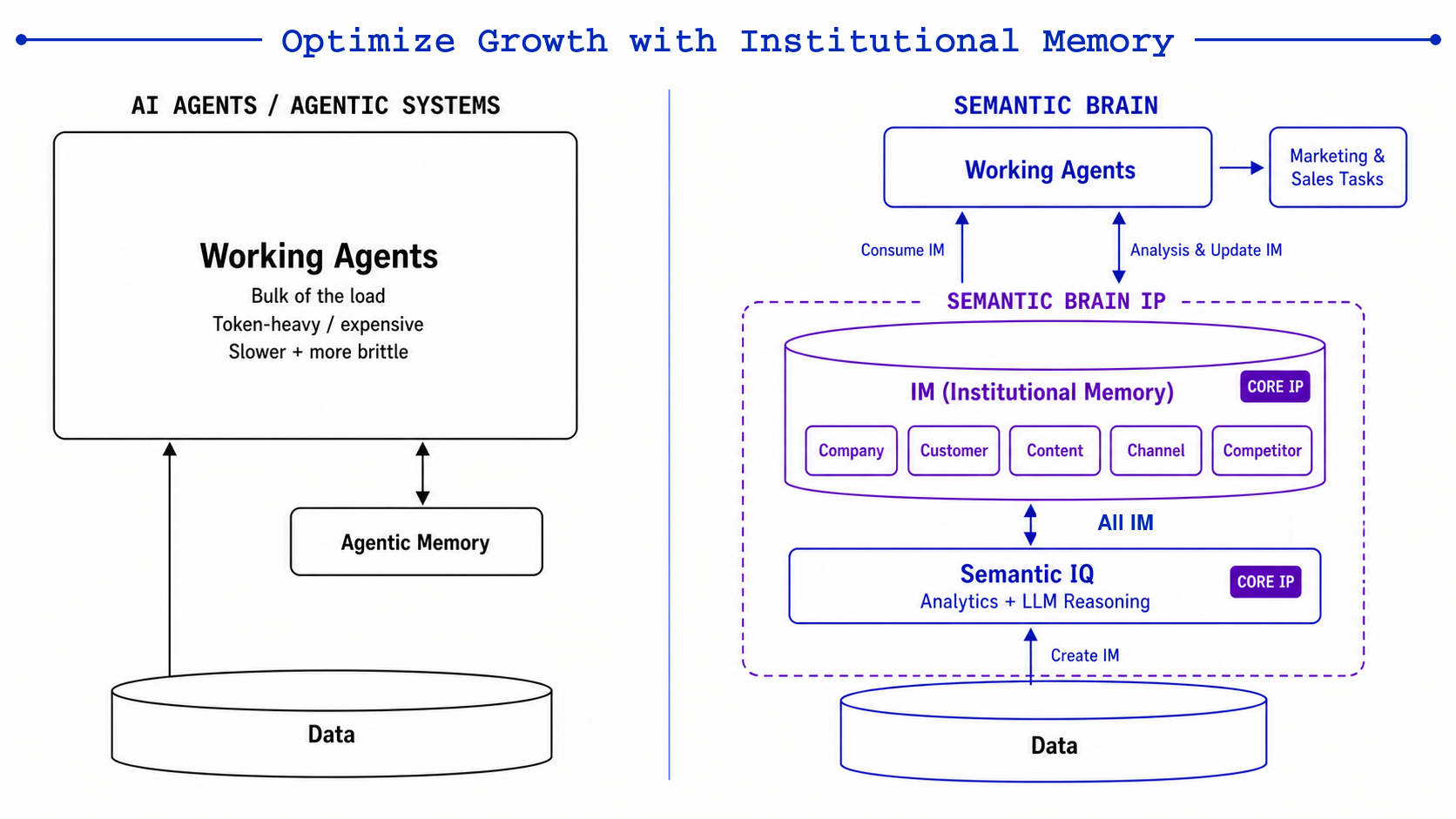
Institutional Memory is the component within the Semantic Brain App that learns. Not from its interactions with one operator — from the organization's past performance across its digital channels, and from how the organization uses the App over time. The unit of learning is the company, not the seat, so every audit, attribution run, and campaign sharpens the next one instead of starting from zero.
An agent that remembers you is not a system that knows your business.
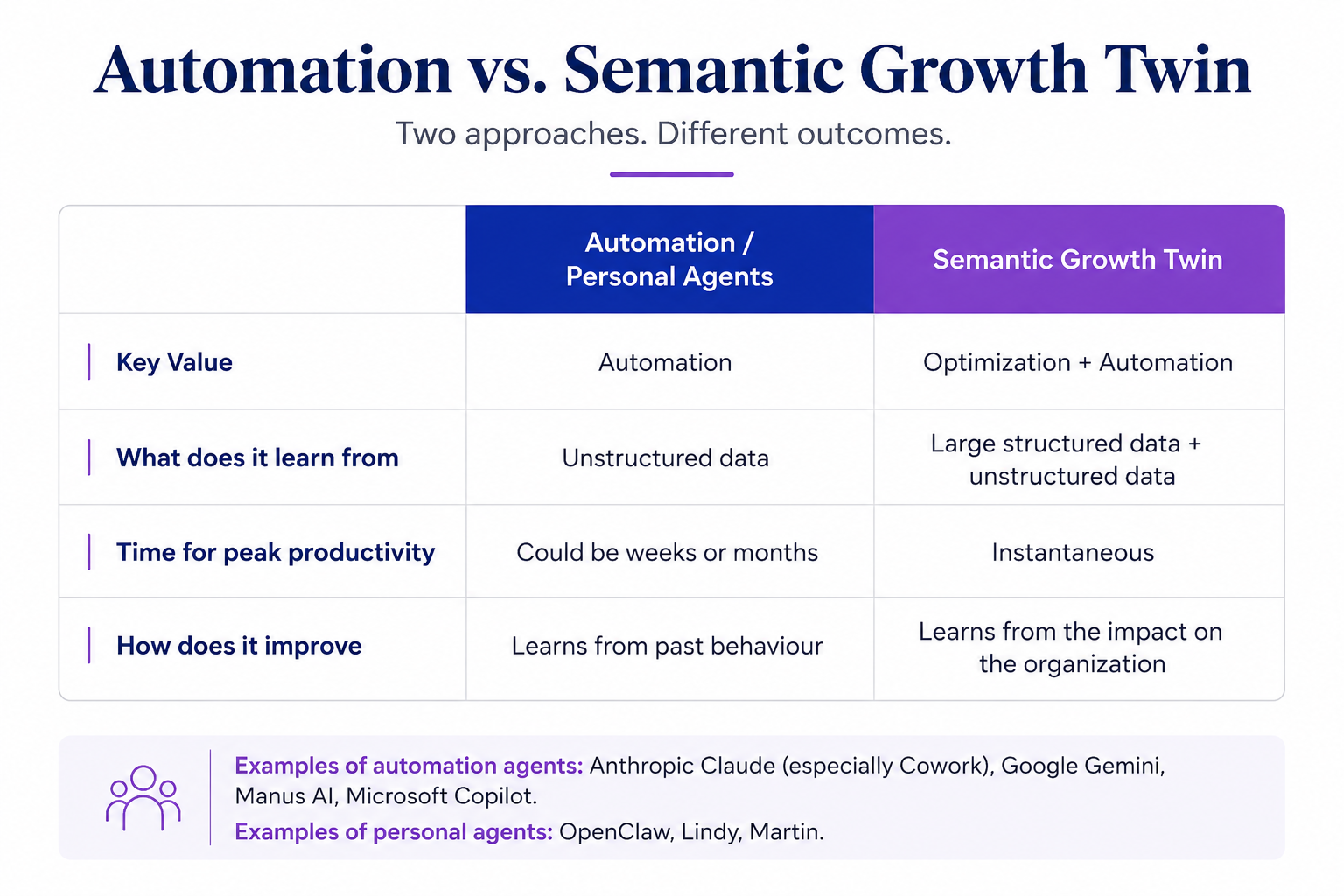
The two are easy to confuse because they share a word. A conventional Gen AI agent builds memory from its interactions with you — your phrasing, your preferences, the way you like a report laid out. That memory is real, and for personal productivity it is enough. But the thing it remembers is you. Not which campaigns returned and which quietly drained budget for three quarters. Not why a channel that worked last year stopped working. The operator's habits are in the model; the operation's history is not.
A record of interactions
Bounded by the person it happens to be sitting with. It makes one operator faster every week — genuine convenience, but it walks out the door with the seat, and it can only reproduce the patterns it was shown.
A record of the operation
What the channels did, what customers responded to, what worked and what was waste — accumulated and carried forward. The more the App runs against a company's data, the sharper its baseline becomes.
One is an assistant that knows you. The other is a system that knows your business. One is convenience. The other compounds.
The Semantic Growth Twin. Not a replica — a memory of what moves the number.
Institutional memory needs somewhere to live. For us, that is the Semantic Growth Twin. It rests on one premise: there is a fundamental performance gap between a system taught to mimic existing behaviour and a system that understands what worked, what didn't, and why. The first inherits a ceiling — it can only reproduce the patterns it was shown. The second compounds, because every cycle adds to what it understands. Over time, those two paths separate, and they do not reconverge.
The Growth Twin mirrors a company's entire ecosystem — the company, its customers, and, where it matters, its competitors. A replica tries to copy everything; the Growth Twin keeps only what changes outcomes. It persists growth signals and waste signals, holds them in compressed form, and tracks progress against them. Memory persists only where it matters: in signals, deep diagnostic insights, and recommendations — so the layers above it reason on distilled knowledge, not raw history.
Five categories. Nearly every marketing and sales use case.
Signal is only useful when it is structured. The Semantic Growth Twin organizes what it remembers around five categories — the 5Cs.
- C1 · Company
The business itself
Its products and services — what the company brings to market and what growth is being optimized against.
- C2 · Customer
Segments, defined the way the market defines them
For B2C, customer segments by demographics (age, gender, household income) and psychographics (affinity and in-market intent). For B2B, sector, industry, account, and the firmographics that describe them.
- C3 · Content
What's working, and for whom
Which content and topics are working — what customers search for, and what they actually engage with once they arrive.
- C4 · Channel
Not just the type — the specific channel
SEO, social, and paid — and within them LinkedIn, YouTube, Instagram, TikTok, each with its own behaviour.
- C5 · Competitors
The options a customer weighs instead of you
Direct, indirect, and alternatives — the competitive context every acquisition and retention question ultimately runs against.
Once you hold the growth signals and the inefficiency indicators for all five Cs, you can address nearly every marketing and sales use case — optimally. Acquisition, retention, channel mix, content strategy, segmentation, competitive positioning: they all decompose into questions about those five categories. The reach extends past marketing, too — many product-management questions are answerable from the same structured memory.
The real output of the loop is not an optimized campaign. It is a faster loop.
Look at how the pieces connect. Audit IQ ensures data quality. Semantic IQ runs attribution and drives optimization, with BizML underneath it. Gen AI agents handle execution. Institutional Memory captures the learning from every action — and feeds it back to the start, so each turn of the loop starts ahead of the last, and starts faster, because the system is not relearning what it already knows.
Day 1
Time to peak productivity. Attribution and the curated signal layer give the system its context from the start — no months of behavioral observation before it produces value.
Structural · not aspirational
1/100th
LLM token consumption when reasoning runs on pre-structured signal instead of raw exports — the difference between analysis you run continuously and once a quarter.
As little as · search & ad query analysis
2
Growth curves, not one: revenue growth on top, learning growth underneath. When learning growth is flat, every new dollar of revenue costs as much as the last. When it rises, future growth gets cheaper.
Revenue · learning rate
Memory sets the pace of learning. A learning culture raises it. In a market shaped by AI, speed is the success factor — and Institutional Memory is what makes that speed possible.
Read: Personal memory makes agents helpful. Institutional memory makes companies compound →
Read: AI transformation isn't about the Gen AI agents. It's about how fast you learn →
Knowledge that doesn't reset.
Every cycle sharpens the next
Every audit, attribution run, and campaign adds to what the system understands — across people, teams, and time — instead of restarting with each quarter, each hire, or each tool change.
Lessons that stay learned
What worked, where, and why — captured as measured, attributable, repeatable knowledge and made available across teams, so the company stops paying full price to relearn it.
The memory belongs to you
The signals and deep insights accumulate to the organization — and for agencies, across every client they run. Staff learn alongside the system, shaping its analysis and execution.
Start compounding instead of restarting.
Every demo includes a complimentary Audit IQ — a public business and technical audit of a target account before any access is required. If the account moves forward, connected data lets you quantify the leak, optimize spend, and prove outcomes — and every cycle after that starts ahead of the last.