
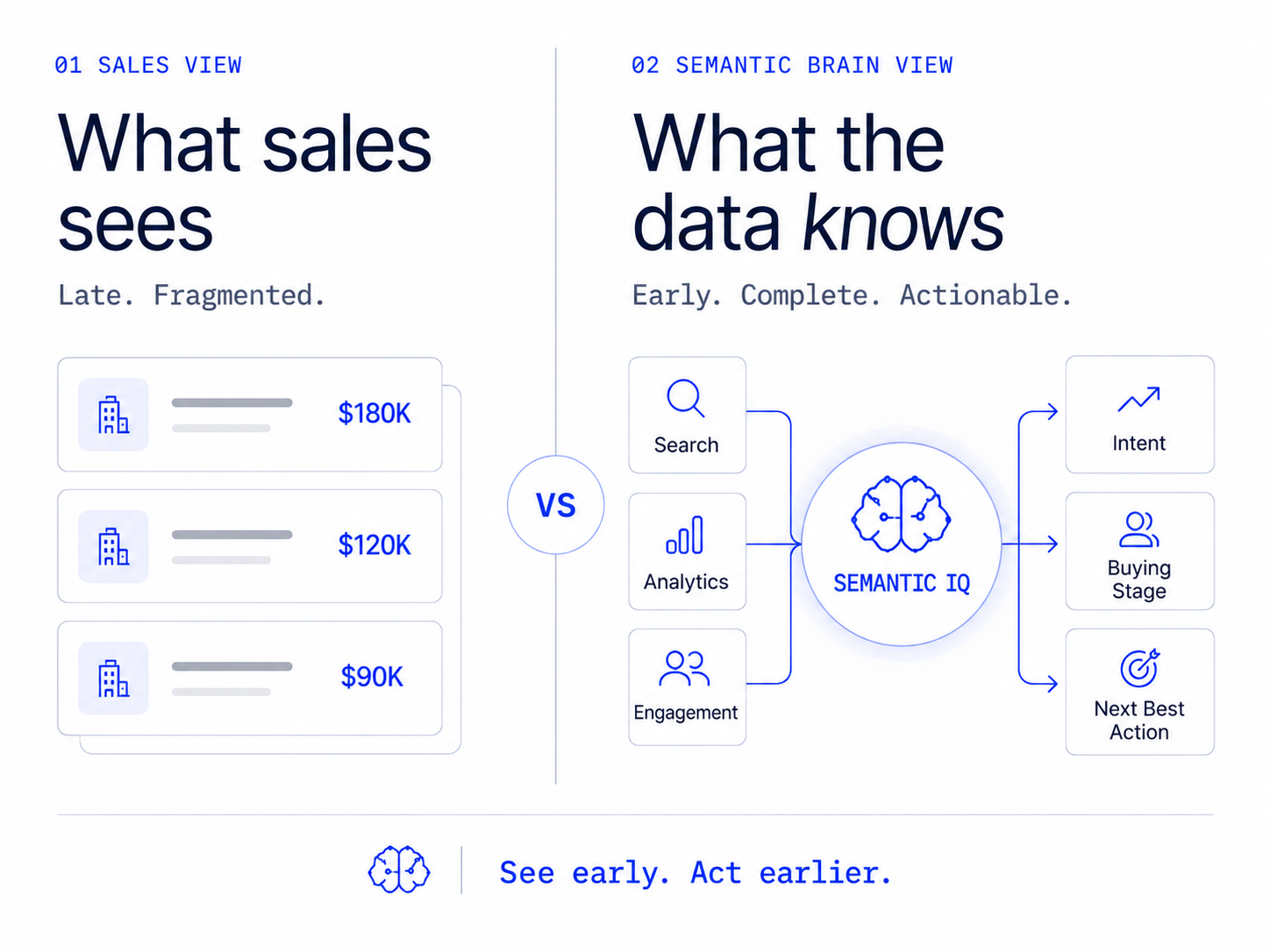
What sales sees versus what the data knows — Semantic IQ comparison
For B2B

Buyers went digital. Sales didn’t.

B2B buyers now run 80% of the buyer journey without ever speaking to a vendor. They research independently, compare quietly, and arrive — when they arrive — already most of the way decided. Sales-heavy organizations that underinvested in measurable digital infrastructure are losing deals they can’t see leaving. Analytics, properly grounded, tells you exactly where.

01 — The shift

From 57% to 80%. In nine years.

The B2B buyer’s behaviour has moved in one direction for a decade. Each milestone is a different study from a credible source. The trajectory is the same.

2015
57%

of the buyer journey already occurring without sales contact.

CEB / Gartner
2019
70%

of the buyer journey now self-directed by the buyer.

Forrester
2024
80%

of the buyer journey occurring without direct vendor contact.

Gartner
17%

of total buying time spent in direct contact with vendors — and that share is split across every vendor under consideration.

Gartner · 2024
87%

of B2B buyers prefer to research product information on their own before speaking with a sales representative.

TrustRadius · 2023
6%

of total decision-making time is spent with any one vendor in particular.

TrustRadius · 2023

This is not a trend that will reverse. The B2B teams winning in 2026 are the ones that built the measurement layer to see what’s happening in the 80% sales never touches.

02 — Where revenue leaks

Long cycles. Dark funnels. Real leaks.

Three places B2B revenue quietly leaves — one is a timing problem, one is a measurement problem, one is a visibility problem. Each is fixable. Each requires a different fix.

Long cycles

Don’t wait six months to find the leak.

A six-month B2B cycle is also six months of acting on whatever attribution you happened to start with. By the time a campaign’s real performance is knowable, the next two quarters of budget are already deployed — against the wrong assumptions. The cycle itself becomes the reason you can’t correct course.

What changes: Semantic IQ establishes a baseline at onboarding and updates it continuously — the leak surfaces in weeks, not quarters, while the budget is still recoverable.
Sales-heavy organizations

Sales can’t see it. Marketing can’t trust it.

The buyer moved online faster than the measurement infrastructure did. Sales sees almost nothing happening in the 80% — no trigger, no signal, no read-back to the original touch. Marketing has a partial view, but the setup is rarely clean: tracker hygiene patchy, attribution configuration improvised. The result is the same on both sides of the team — no one has a read they can trust.

What changes: Audit IQ inspects and fixes tracker hygiene and attribution configuration across GSC, GA4, Google Ads, and LinkedIn — so sales and marketing finally look at the same trustworthy data.
Dark funnels

Some you never see. Some you can’t explain.

Two patterns, both invisible to standard attribution. First: prospects research independently, compare your digital presence against competitors with stronger ones, and quietly self-disqualify — or pick someone else. They never arrive in your pipeline. Second: they do arrive, take a meeting or two, and then go silent. Sales never finds out why, because the signal that explained their interest — and the one that explained their disappearance — was never captured. The dark portion is where most B2B revenue actually goes missing.

What changes: Semantic IQ captures behavioural signal continuously across the funnel, not just at entry — so when something moves, the analytics can tell you what moved and where.

The pattern repeats across the segment: long cycles compound bad data, sales-heavy organizations have neither the visibility nor the clean measurement to trust what they do see, and the dark portion takes deals — some you never see, some you can’t explain. Analytics is what tells you which leak is yours.

Case study
03 — In practice

A 7% spend increase. A 700% lift in conversions.

Sector

Security SaaS · Silicon Valley

+700%
Conversions, post vs. prior period
+7%
Additional ad spend — $2,640 over four months
4mo
Comparison window, before and after

A Silicon Valley security SaaS company applied Semantic IQ to the digital marketing spend it was already running. The deliverable wasn’t a dashboard. It was a set of prescriptive answers to four operational questions:

  1. 01Which keywords are actually driving conversions?
  2. 02Which keywords are quietly burning budget?
  3. 03Who should be in the retargeting audience?
  4. 04Where should the next dollar of budget go?

A 7% increase in ad spend — just $2,640 over four months — produced a 700% increase in conversions against the four months prior. The lift didn’t come from spending more. It came from spending the same budget where the analytics said it would actually work.

Optimization isn’t a synonym for “more.” It’s a synonym for “where.”
Get started

Book a demo. Free audit included.

Every demo includes a complimentary Audit IQ — a business and technical pass over your marketing data pipeline. For B2B teams, that means a read on exactly which trackers are deployed, what they’re measuring, and where in the dark portion of the funnel deals are leaving.