
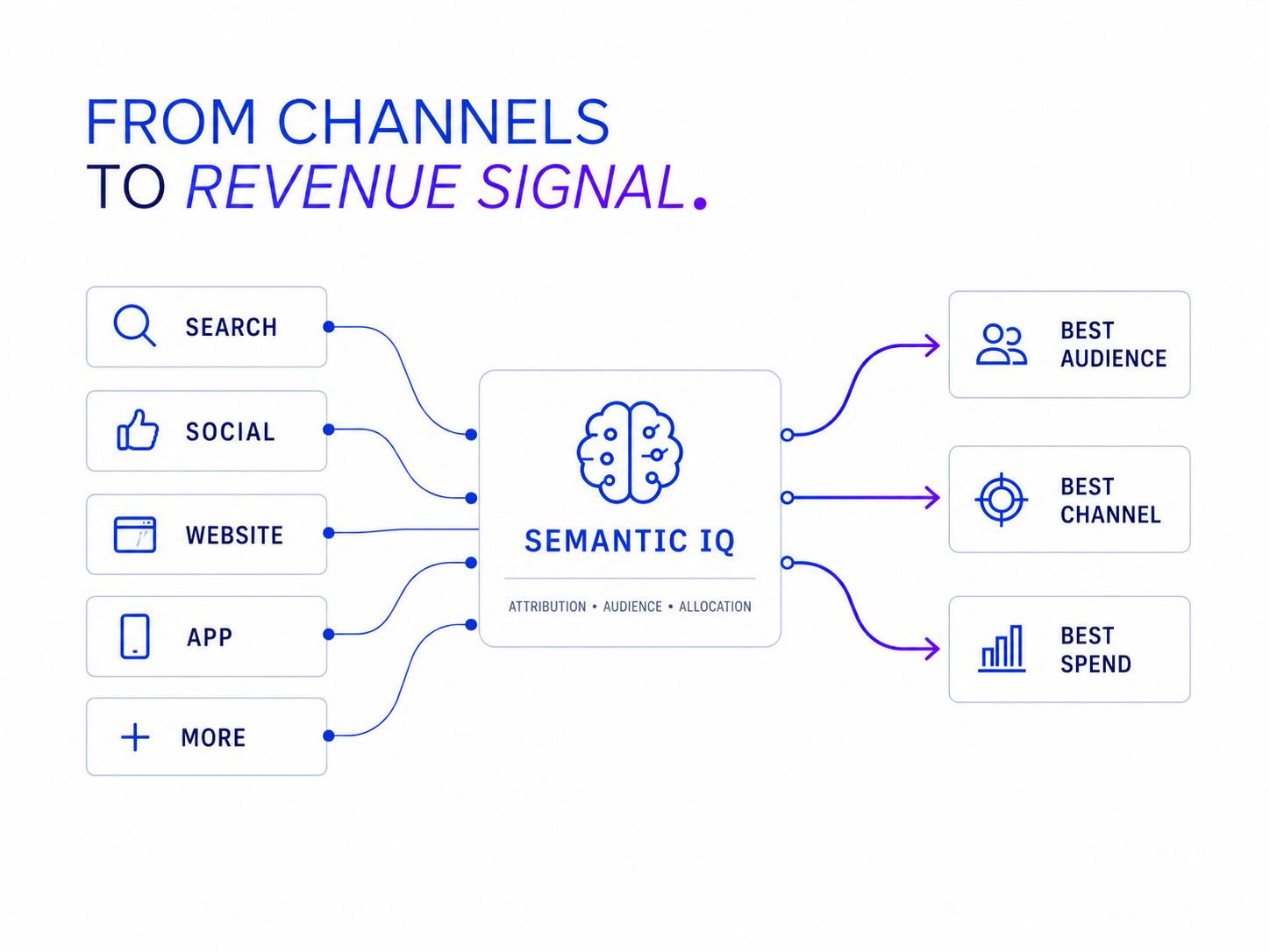
From channels to revenue signal — Semantic IQ unifies search, social, website, app, and more into best audience, best channel, and best spend.
For B2C

Your channels exploded. Your revenue didn’t.

B2C teams now run paid spend across search, social, creators, commerce media, websites, apps, email, and AI search. Every channel reports its own version of success. Without trustworthy attribution and audience intelligence underneath them, the budget spreads wider while revenue stays where it was. Analytics, properly grounded, tells you which channels and which audiences are actually moving the business.

01 — The shift

B2C marketing didn’t get easier. It got wider.

The U.S. digital ad market crossed $294.6 billion in 2025. The growth didn’t come from new channels replacing old ones — it came from layering new channels on top of channels the previous decade already considered crowded. The result is a paid-media surface no B2C team has time to optimize one platform at a time.

Total scale
$294.6B

U.S. digital advertising revenue in 2025 — a record, achieved with no Olympics, World Cup, or U.S. election cycle to inflate it. Up 13.9% YoY.

IAB · PwC · 2026
Social media
$117.7B

U.S. social media ad revenue, +32.6% YoY — an additional $29 billion in a single year, largely from creator economy and deeper commerce integration.

IAB · PwC · 2026
Commerce media
$63.4B

U.S. commerce media ad revenue, +18% YoY — a performance channel sitting inside retailer networks most B2C teams don’t fully measure against the rest of their stack.

IAB · PwC · 2026

B2C used to be the easier side of the buyer journey to read: launch a campaign, watch the traffic, measure the sale. Now the customer journey cuts across search, social, creators, ads, retail media, reviews, email, and AI-generated answers. Each platform reports its own version of success. None of them tells the whole truth.

02 — Where revenue leaks

Audience assumptions. Channel misallocation. Platform bias.

Three places B2C revenue quietly leaves — one is an assumption problem, one is an allocation problem, one is a measurement problem. Each is fixable. Each requires a different fix.

Audience assumptions

Who you think is buying. Who actually is.

Most B2C teams know the buyer persona that won the last strategy offsite. Whether that persona is also the segment converting — by age, location, device, search intent, channel behaviour, interest, and affinity — is a separate question. The two routinely disagree. Spend continues against the persona; revenue continues from a segment the team can’t see in any one platform’s reporting.

What changes: Semantic IQ identifies which demographics, psychographics, search behaviours, locations, and interests actually correlate with conversion — not which ones the brief assumed would.
Channel misallocation

Where the budget goes vs. where the revenue comes from.

Spend gets split across Google Ads, paid social, SEO, creators, commerce media, email, and retargeting. Every channel reports favourably on itself. None reports honestly on the others. Budget tends to follow the channel with the loudest dashboard — not the one with the strongest signal across the customer journey.

What changes: Semantic IQ runs attribution across the full paid surface — so the next dollar follows the channel that actually moved the customer, not the one that claimed it did.
Platform attribution bias

Each platform wants the credit. None wants to share it.

Google, Meta, TikTok, and LinkedIn each measure conversions in a way that maximizes their own contribution. Run them all and the sum of platform-reported conversions exceeds the conversions the business actually had. Teams then optimize inside each platform instead of optimizing for the business — and the wedge between platform-reported and actual revenue is where the budget quietly leaves.

What changes: Audit IQ inspects tracker hygiene and attribution configuration across the stack; Semantic IQ reconciles the platforms against one trustworthy baseline.

The pattern is consistent across B2C accounts: not one large leak but several small ones that compound. Optimization isn’t a content problem. It’s an allocation problem — the right audience, the right message, the right channel, the right moment.

Case study
03 — In practice

Same campaigns. Half to a third the cost.

Sector

Consumer services · Dog training

½–⅓
Cost per result, post vs. prior period
Customer-pull
Search intent the budget now targets — outperformed Performance Max
Reallocated
Same budget, concentrated on best-converting locations and keywords

A consumer-services business — a local dog training practice — applied Semantic IQ to a Google Ads spend that was already running. The deliverable wasn’t a new campaign. It was a set of prescriptive answers to four operational questions:

  1. 01Which search queries are pulling in customers — and which ones are just spending budget?
  2. 02Which campaign type — Performance Max or Search — is doing the converting?
  3. 03Which locations are returning customers, and which aren’t?
  4. 04Where should the next dollar of budget go?

The answers were unambiguous. Customer-pull Search Ads — those targeting queries with explicit purchase intent — significantly outperformed both Performance Max and the older, broader search campaigns. Underperforming keywords were removed. Budget was concentrated on the locations that converted best. Cost per result fell to between half and one-third of the prior baseline. The campaigns didn’t get bigger. The targeting got better.

Optimization isn’t a synonym for “more.” It’s a synonym for “where.”
Get started

Book a demo. Free audit included.

Every demo includes a complimentary Audit IQ — a business and technical pass over your marketing data pipeline. For B2C teams, that means a read on which trackers are deployed across your channels, what they’re measuring, and where in the customer journey the spend isn’t producing customers.