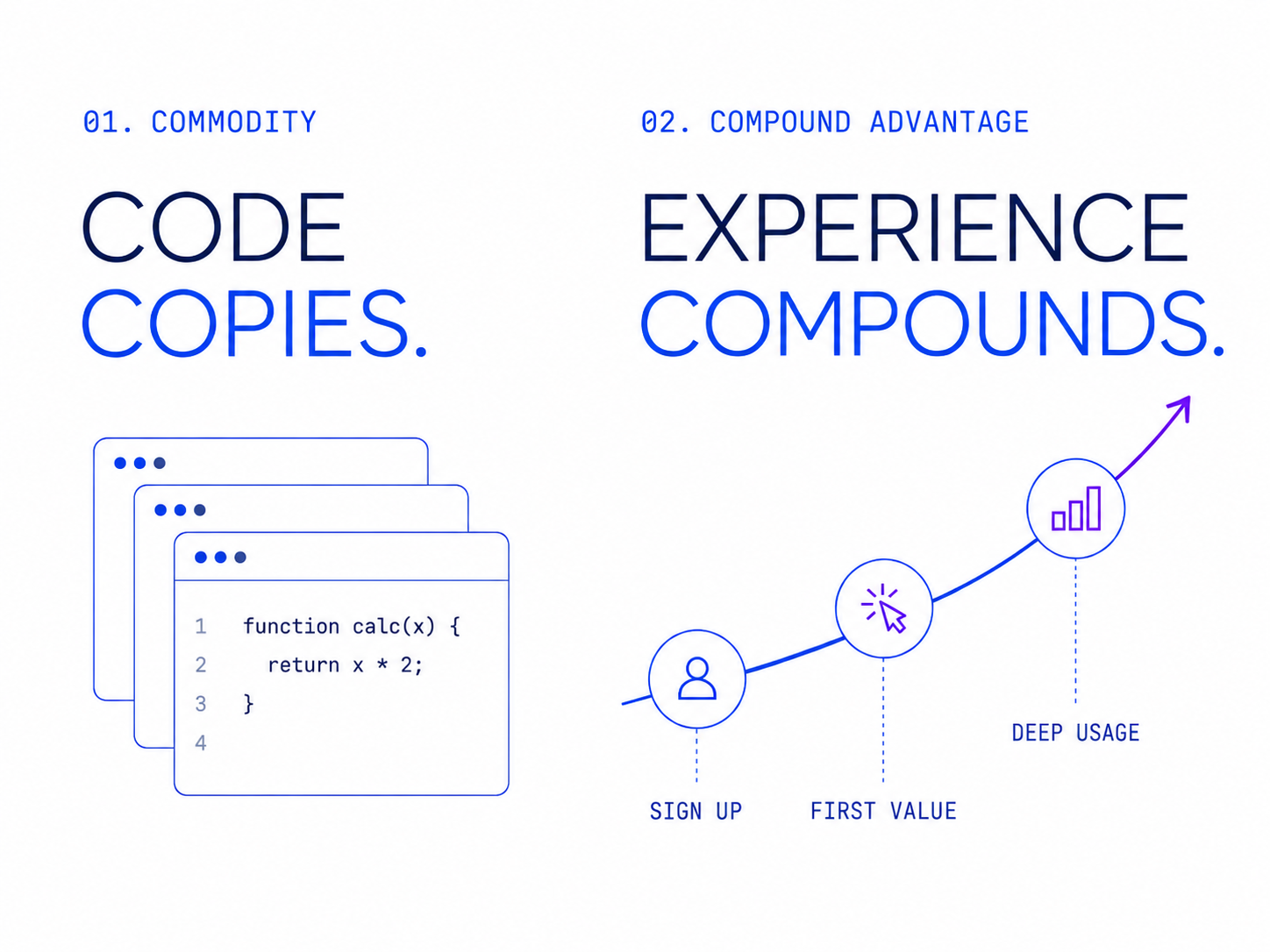
Code copies. Experience compounds.
For SaaS

Code is becoming a commodity. Customer experience isn’t.

SaaS companies used to win because they built better software. Gen AI is making code faster, cheaper, and easier to copy. The next moat is what code alone cannot replicate — how quickly customers discover value, how intelligently the product guides them, and how cleanly the business can connect usage back to revenue.

01 — The shift

The moat is moving. From code to customer experience.

The SaaS retention numbers are public, and they are not encouraging. Out of every 100 new users a software product acquires, an average of 39 are still around after one month, and 30 after three. The companies winning the next decade are not the ones shipping features faster — they are the ones closing the gap between signup and value.

One-month retention
39%

of new users still returning to the average software product 30 days after first visit. The other 61% never come back.

Pendo · 2025 SaaS benchmark
Three-month retention
30%

of new users still returning at 90 days — meaning seven out of ten people who tried the product have already left.

Pendo · 2025 SaaS benchmark
Top-decile gap
1.9×

retention advantage held by the top 10% of software products at three months. The gap is not the code — it is what happens between signup and habit.

Pendo · 2025 SaaS benchmark

Better software is still necessary. It is no longer sufficient. Where the top decile separates from the average is in the months after signup — in activation, onboarding, and the product’s ability to surface its own value before the user gives up.

02 — Where SaaS growth leaks

Activation. Allocation. Intelligence.

Three places SaaS growth quietly leaves — one between signup and value, one between marketing and product, one between data and decision. Each is fixable. Each requires a different fix.

Activation leakage

Most users never see the value.

The first 30 days decide everything. The average software product loses 61 of every 100 new users in that window — not because the product is broken, but because the path from signup to a meaningful first outcome is too long, too generic, or too easy to abandon. Activation is a measurement problem before it is a product problem.

What changes: Semantic IQ identifies which acquisition sources, audiences, onboarding paths, and early product behaviours actually correlate with users who stay — so the team can stop guessing about the first 30 days.
GTM–product disconnect

Marketing measures signups. Product measures usage. The business needs both.

Marketing optimizes for leads, demos, signups, and trials. Product optimizes for usage and retention. Neither side can answer the question that matters most: which acquisition sources, campaigns, and audiences produce users who activate, retain, and expand. The data exists on both sides — it just does not meet in the middle.

What changes: Audit IQ and Semantic IQ connect Google, ads, CRM, and product usage into one analytical surface — so optimization runs against valuable users, not just signups.
Product intelligence gap

Most apps show dashboards. Few explain what to do next.

SaaS products are full of metrics, reports, and charts. They are not full of explanations. End users see what happened but rarely why — and almost never what to change. The intelligence layer that separates a useful dashboard from a useful product is the same layer Semantic Brain already builds for marketing and sales.

What changes: Semantic IQ can run inside the SaaS product itself — surfacing diagnostic explanations, prescriptive recommendations, and proactive alerts to end users, not just to the team behind the product.

The pattern is consistent: the code is rarely the leak. The leak is in the surface around the code — the acquisition that does or does not produce activated users, the onboarding that does or does not surface value, the intelligence that does or does not explain what is happening.

03 — Two ways in

Optimize the first 30 days. Then embed intelligence in the product itself.

SaaS is the one segment where Semantic Brain’s analytical infrastructure can do two distinct jobs. The first sits where the other audience pages sit — optimizing the marketing and sales surface around the product. The second is unique to SaaS: the same intelligence layer can run inside the product, for the product’s own users.

Semantic IQ First 30 days

Turn onboarding into an intelligence loop.

The first month is the entire game. Audit IQ cleans the analytics surface across acquisition; Semantic IQ then connects acquisition signal to early product behaviour, so the team can act on what actually predicts retention — not what looked promising in the signup form.

  • Which acquisition channels produce users who activate, not just users who sign up.
  • Which signup sources, audiences, and segments quietly underperform on retention.
  • Which onboarding steps cause measurable drop-off — and which ones predict habit.
  • Which users should get a sales touch, a CS nudge, or an in-app prompt — and when.
What it replaces: separate marketing dashboards, product analytics tools, and CRM views that no one in the business can reconcile against the same truth.
Semantic IQ Inside the product

Make the app smarter without rebuilding it.

The intelligence layer Semantic Brain already builds for marketing and sales can run inside the SaaS product itself. Customers see explanations rather than charts, recommendations rather than reports, and proactive alerts rather than dashboards they have to interpret on their own.

  • Dashboards that explain themselves — in plain language, grounded in the underlying data.
  • Reports written by Gen AI on top of structured analytics, not raw metrics.
  • Recommendations and next-best actions personalized to each user’s behaviour.
  • Proactive alerts when a signal moves — before the customer has to go looking for it.
How: BizML pre-structures the analytics before the reasoning layer runs — which is why the answers inside the product come back grounded instead of hallucinated.

The first motion makes the SaaS company smarter about its customers. The second makes the SaaS product smarter for its customers. Most companies need both. Few realize the same analytical infrastructure can deliver them.

04 — By business model

SaaS isn’t one shape. Neither is the fix.

B2B SaaS leaks differently than B2C SaaS. Product-led companies leak differently than sales-led ones. The analytical framework is the same; what changes is which leak gets prioritized and which signals carry the most weight.

B2B SaaS

Long sales cycles, dark funnels, demo-to-close leakage that takes quarters to surface.

Connect digital behaviour, account signal, sales motion, and product usage on one analytical surface.

B2C SaaS

High signup volume, fragmented channels, retention numbers that match the industry average rather than beating it.

Identify which audiences and channels produce activated, retained users — not just signups the dashboards celebrate.

Hybrid SaaS

Multiple buyer journeys, multiple product motions, multiple definitions of activation across segments.

Segment users by behaviour, source, role, and value potential — then optimize each segment against its own definition of success.

Product-led SaaS

Users enter the product before speaking to anyone. Most of them leave before anyone notices.

Detect activation signals in real product behaviour and trigger the right sales, CS, or in-app response at the right moment.

Sales-led SaaS

Product usage data exists. Sales rarely sees it. Expansion and retention forecasts are built on the wrong signal.

Use product intelligence to prioritize accounts, surface expansion opportunities, and de-risk renewals before they slip.

Case study
05 — In practice

Same product. Smarter growth engine.

Sector

Security SaaS · Silicon Valley

+700%
Conversions, post vs. prior period
+7%
Additional ad spend — $2,640 over four months
4mo
Comparison window, before and after

A Silicon Valley security SaaS company applied Semantic IQ to the digital marketing spend it was already running. The deliverable was not new software. It was a set of prescriptive answers to four operational questions:

  1. 01Which keywords are actually driving conversions?
  2. 02Which keywords are quietly burning budget?
  3. 03Who should be in the retargeting audience?
  4. 04Where should the next dollar of budget go?

A 7% increase in ad spend — $2,640 over four months — produced a 700% lift in conversions against the four months prior. The lift did not come from rewriting the software. It came from identifying which acquisition signals were connected to real conversion behaviour, then reallocating spend accordingly.

This is the lift that was available before the product changed at all. For SaaS companies, the next step is more powerful still: connect those acquisition signals to what happens after signup — activation, onboarding, retention, expansion — and the same analytical framework optimizes the entire growth journey, not just the surface that brought the user in.

The product was the same. The growth engine got smarter.

Get started

Book a demo. Free audit included.

Every demo includes a complimentary Audit IQ — a business and technical pass over your marketing data pipeline. For SaaS companies, that means a read on where the growth journey breaks: acquisition, activation, onboarding, usage, retention, and the product intelligence opportunities that sit alongside them.