
For Agencies

Stop billing hours. Start billing outcomes.

Gen AI made content execution faster, cheaper, and easier to copy. The agencies winning the next contract are the ones that can diagnose what is broken, prove what is working, and tie deliverables to outcomes the client can verify. Audit IQ and Semantic IQ are the instruments that get an agency there — one before the contract exists, the other after it does.

01 — The shift

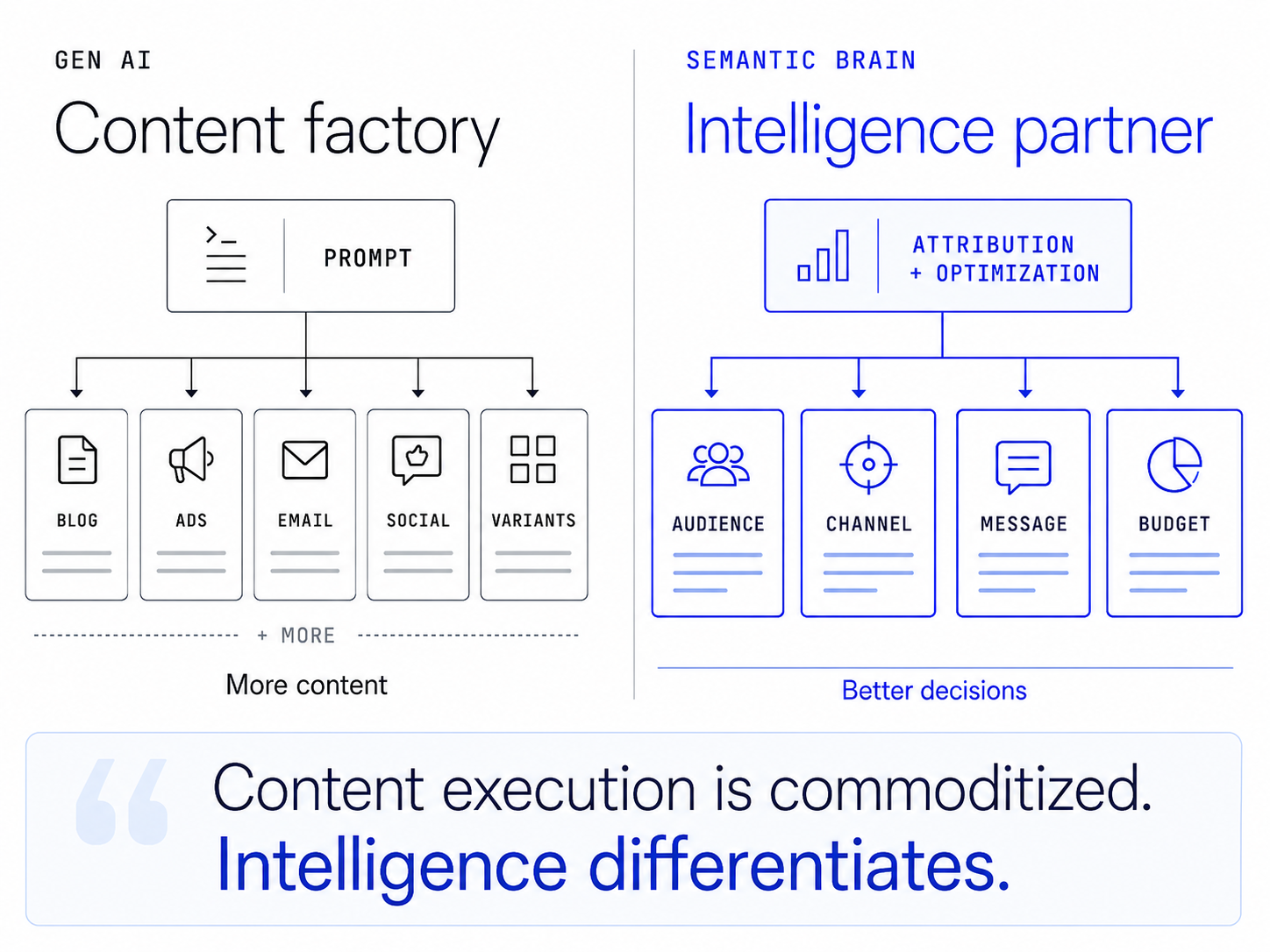
Execution is being commoditized. Intelligence is the differentiator.

For years clients have asked agencies to prove results through attribution. Gen AI added a second pressure at the same time: content production is no longer scarce. Drafting, ideation, summarization, and campaign variations are now table stakes — available to anyone with an API key.

Adoption
60%

of US agency decision-makers are already using Generative AI in production, with another 31% actively exploring it.

Forrester
Budget intent
39%

of CMOs plan to cut agency budgets — with marketing budgets flat at 7.7% of revenue and 59% saying they are under-resourced to execute strategy.

Gartner · 2025 CMO Spend Survey
Substitution
22%

of CMOs report that Gen AI has already reduced their reliance on external agencies for creativity and strategy work.

Gartner · 2025

Agencies cannot defend premium pricing by producing more content faster. Clients can do that themselves now. What clients will pay for is a clear answer to the question they cannot answer on their own: where is growth leaking, and what should we do about it?

02 — The position

Move from execution partner to intelligence partner.

Semantic Brain gives agencies two distinct motions backed by one application: a pre-sales diagnostic that opens conversations, and an optimization engine that keeps clients explaining their results instead of guessing at them. Each does work the agency cannot do today without significant analyst time.

Audit IQ Pre-sales

Win the meeting before the meeting.

Audit IQ works from publicly available information to map a prospect’s analytics surface — site content, deployed trackers, marketing posture, and data-pipeline gaps. Before access. Before onboarding. Before weeks of discovery. The output is a prioritized read on what is broken and where the agency can help.

  • Outbound grounded in observed gaps, not generic pitches.
  • Account prioritization scored against measurable opportunity.
  • One-pagers and decks built directly from the audit output.
  • Converts into the scoped engagement on day one — no second discovery.
What it replaces: hand-built audit decks that take days of analyst time and arrive after a prospect has already lost interest.
Semantic IQ BizML inside

Explain performance. Don’t just report it.

Dashboards show what happened. Generic Gen AI summarizes what happened. Semantic IQ identifies why performance moved and what to change next. Defensible attribution, reliable baselines, campaign diagnostics, and prescriptive recommendations — the intelligence layer clients have been asking for and that hourly execution work cannot deliver.

  • Continuous attribution across GSC, GA4, Google Ads, and LinkedIn.
  • Diagnostic insights: which channels, keywords, audiences, and messages are working.
  • Prescriptive solutions, not just “here is a chart.”
  • Outcome reporting clients can verify against their own systems.
How: BizML pre-structures the raw analytics before the reasoning layer runs — which is why the answers come back grounded instead of hallucinated.

Generative AI still handles the content. Semantic Brain decides what to produce — for which audience, through which channel, with what message, and why. Generate after you know what to generate.

03 — The business model

From hourly production to outcome-linked growth.

The agency model does not need to disappear. It needs to move up the value chain. Content creation becomes execution. Audit, attribution, and optimization become the premium layer — repeatable, packageable, and tied to results the client can see for themselves. Four service archetypes Semantic Brain makes possible:

01

Marketing Intelligence Audit

The pre-sales diagnostic packaged as a billable, scoped engagement. Sold before access, delivered with it.

02

Attribution Readiness

Get the client’s measurement infrastructure to a state where everything downstream — optimization, reporting, retainer renewal — can be trusted.

03

Campaign Waste Audit

Identify which channels, keywords, audiences, and messages are quietly burning budget — and which ones to reallocate toward instead.

04

Continuous Growth Optimization

The ongoing retained engagement: signal capture, diagnostics, prescriptions, and Gen AI content production grounded in verified attribution.

Case study
04 — In practice

A 7% spend increase. A 700% lift in conversions.

Sector

Security SaaS · Silicon Valley

+700%
Conversions, post vs. prior period
+7%
Additional ad spend — $2,640 over four months
4mo
Comparison window, before and after

A Silicon Valley security SaaS company applied Semantic IQ to the digital marketing spend it was already running. The deliverable wasn’t a dashboard. It was a set of prescriptive answers to four operational questions:

  1. 01Which keywords are actually driving conversions?
  2. 02Which keywords are quietly burning budget?
  3. 03Who should be in the retargeting audience?
  4. 04Where should the next dollar of budget go?

This is the kind of result an agency can put in front of a client. Not more content. Not more hours. Not more dashboards. Better allocation of the budget the client is already spending. A 7% increase in ad spend — $2,640 over four months — produced a 700% lift in conversions against the four months prior. The lift came from spending the same budget where the analytics said it would actually work.

Optimization isn’t a synonym for “more.” It’s a synonym for “where.”
Get started

Give every prospect a reason to talk.

Every demo includes a complimentary Audit IQ — a business and technical pass over a target account’s marketing data pipeline. For agencies, that means a diagnostic to take into a sales conversation: which trackers are deployed, what is being measured, where the marketing gaps are, and where the conversation should start.