Why it works

Growth requires more than Gen AI.

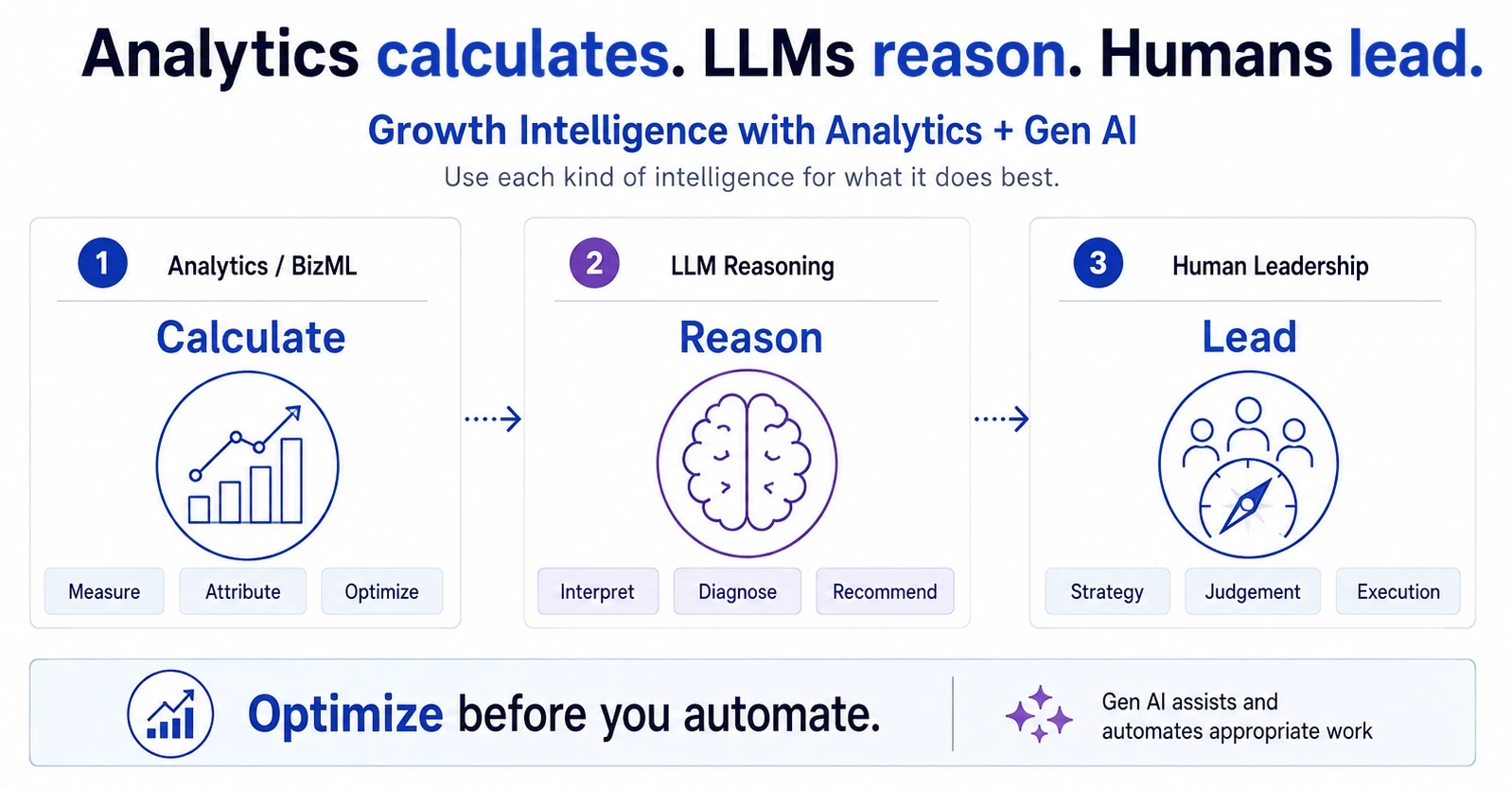
Analytics calculates. LLMs reason. Humans lead.

Semantic Brain combines each where it adds the most value — turning reliable data into Growth Intelligence, helping your team make better decisions, and automating the work that shouldn't require their attention.

The operating model
Semantic Brain framework showing Analytics and BizML calculating and optimizing, LLM reasoning interpreting and recommending, and human leadership guiding strategy, judgement, and execution, with Gen AI assisting appropriate automation.
Analytics calculates. LLM reasoning turns that structure into understanding. Your team leads. Gen AI assists and automates the work that should be automated — after optimization, not before.
01 — The thesis

Use each kind of intelligence for what it does best.

The problem with most AI deployments isn't the model. It's the assignment. Ask a language model to do arithmetic across millions of rows and it guesses. Ask a marketer to set a channel budget with no attribution and they guess too. Ask an analytics pipeline to explain what a number means and it can't. Ask any of them to decide what your business should do next and you've handed away the part that mattered. The result of getting the assignment right isn't simply better AI — it's a better operating model for growth.

Growth Intelligence

The combination of trusted data, analytics, and LLM reasoning used to understand what is driving business performance, identify opportunities, diagnose problems, and recommend actions that improve growth.

Analytics / BizML
Calculate

Repeatable numerical work, done the same way every time — and verifiable when someone asks how you got there.

  • Measurement and aggregation
  • Attribution across channels and campaigns
  • Statistical analysis and pattern detection
  • Signal separated from noise
  • Optimization over structured data
LLM reasoning
Understand

Reasoning over calculated output — not over the firehose. This is where numbers become explanations.

  • Synthesis and interpretation
  • Diagnosis and explanation
  • Contextual reasoning and hypotheses
  • Turning analytical output into recommendations
  • Communicating implications
Gen AI
Assist and execute

Repetitive work, content production, drafting, task execution, and workflow assistance. Gen AI scales actions that have already been properly informed — it doesn't decide which actions are worth scaling.

The best system is not AI replacing people. It is each form of intelligence doing the work it is best suited to do.

02 — The order

Automate last. Not first.

Most companies start at the top: generate content, run ads, deploy chatbots. Then they wonder why the numbers don't move. Automation is a multiplier, and a multiplier is indifferent to what it is pointed at — it will scale a correct decision and an invented one at exactly the same rate. The framework only works in dependency order, and automation is the consequence, not the entry point.

04
Automation
Gen AI

Executes correctly — because everything below it is in place, and because the action is defined well enough to be worth automating. The same Generative AI everyone else is using, applied to clean data and verified attribution.

Depends on 01–03
03
Optimization
Semantic IQ BizML inside

Tells you what to do — diagnostic insights and prescriptive solutions. This is Growth Intelligence, and it is the deliverable. Without 01 and 02 it cannot exist.

Depends on 01–02
02
Attribution
Semantic IQ

Measures what's actually working. Establishes the baseline. Sets performance standards across channels and campaigns. Without 01, the math is garbage in, garbage out.

Depends on 01
01
Data quality
Audit IQ

The foundation. Tracker hygiene, pipeline integrity, and governance across GSC, GA4, Google Ads, and LinkedIn. Without this, nothing above it is real.

Foundation
Read bottom to top Each layer requires the one below it. Skip one and the rest collapse.
03 — Data quality

Most accounts were never measuring correctly in the first place.

Audit IQ runs before and after.

Audit IQ was not built as a product idea. It was built because of what we kept finding when we opened customer accounts: acquisition and analytics tools deployed but never configured, conversion events double-firing or silent, tags absent from the highest-intent pages, and channel attribution corrupted at the point of collection rather than in the reporting layer.

The distinction matters. An error in a report can be corrected. An error in collection cannot — the data was never captured, and no amount of downstream analysis recovers it. Every dashboard built on that pipeline was confident, legible, and wrong, and the teams reading it had no mechanism to find out.

Audit IQ does two jobs. Before a customer signs, it works from publicly available information to map their analytics surface. After, it inspects, recommends, and implements the changes that keep data measurable as the business runs.

01

Inspect

Reads the current state of GSC, GA4, Google Ads, and LinkedIn and surfaces what's wrong — tracker hygiene, configuration, pipeline integrity.

02

Recommend

Prescribes specific configuration changes, with the reasoning attached, prioritised by what they unblock downstream.

03

Implement

Applies the changes against the pipeline, so the attribution built on top of it is trustworthy rather than approximate.

04

Govern

Periodic re-runs catch regressions before they corrupt the baseline. The foundation stays sound as the business changes.

Before onboarding

Because the pre-sales audit works entirely from publicly available information, Audit IQ can map a target account's measurement posture before any access exists — which also makes it a prospecting and qualification instrument.

Without this layer, every number that follows is a guess wearing a confidence interval — and it will be defended in a budget meeting by someone who has no idea. With it, attribution becomes a measurement instead of an opinion.

04 — The mechanism

Calculate first. Then reason.

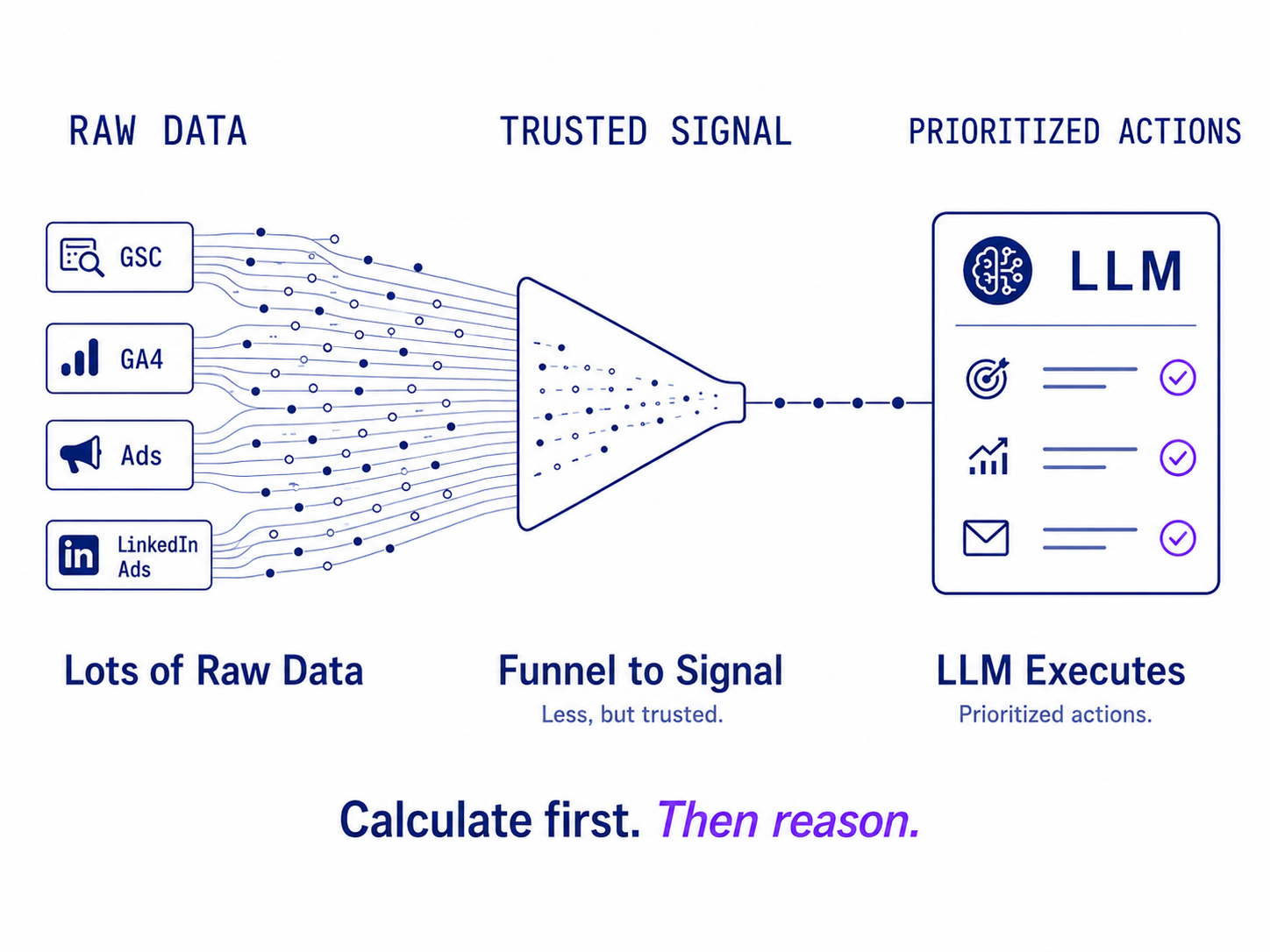
Semantic IQ is the core intelligence of the Semantic Brain App — the component that turns analytics into decisions a marketer can defend. It unifies attribution and optimization into a single flow. The reason it produces reliable diagnostics and prescriptions rather than confident-sounding nonsense is the engine inside it: BizML organizes, sorts, filters, and calculates over the raw data before any reasoning happens.

BizML data flow: raw analytics data from GSC, GA4, Google Ads, and LinkedIn Ads is processed by the BizML calculation engine, then reasoned over by an LLM to produce prioritized actions. Calculate first. Then reason.
Input

Raw analytics

Millions of rows of unstructured signal across four sources.

GSC GA4 Google Ads LinkedIn
Engine

BizML processes

Feature engineering, aggregation, filtering. The calculation that LLMs cannot reliably perform on their own.

Patent-pending
Reasoning

LLM reasons over structure

Operates on pre-structured analytics, not the firehose. Reliable. Explainable. A fraction of the cost.

Output

Growth Intelligence

Diagnostic and prescriptive. Where the leak is. What to do about it. With reasoning a business operator or growth leader can understand, challenge, and act on.

What you get back

Two outputs from one engine.

Attribution: a defensible baseline plus continuous signal across channels and campaigns. Optimization: diagnostic insights that explain why a number moved, and prescriptive solutions for what to change. Both grounded in the same calculated structure.

Why it holds

Structure, then understanding.

Analytics creates the structure. LLM reasoning creates understanding. Together they produce Growth Intelligence — which is a different thing from a model with database access and an optimistic prompt.

05 — The calculator gap

LLMs are not calculators.

They're designed to read, summarize, and reason — not to crunch numbers across millions of rows of analytics data. Feed a model raw GSC, GA4, or Ads data and the failure modes are predictable rather than random.

This is not only a cost problem. An LLM with no calculation step in front of it does not remove the guesswork from a marketing decision. It restates that decision with a machine's confidence attached, at scale, in a register that sounds like proof — and your team stops questioning it. The model did not introduce the problem; a person working without attribution improvises the same way. What it adds is fluency, not signal, and no reason to expect the better answer. That is the thesis underneath the framework, and the reason the order matters.

01

Hallucination

A model with no structuring step in front of it will confidently invent numbers and mis-attribute revenue across channels — in fluent, plausible prose that reads exactly like the correct answer. A wrong answer that announces itself is a nuisance. A wrong answer that reads like analysis is a budget decision.

02

Numerical limits

Arithmetic over large tables is not what the architecture is for. Accuracy degrades as row counts rise, and it degrades quietly — there's no error, just a wrong total.

03

Latency

Pushing raw analytics through a context window is slow. Slow enough that the answer arrives after the moment it was needed, which makes it an artefact rather than a decision input.

04

Cost

Tokens spent doing arithmetic the model was never designed to do bend the cost curve the wrong way — and the curve steepens exactly as your data volume grows.

05

Raw-data inefficiency

Most rows in an analytics export carry no decision-relevant signal. Sending all of them to a reasoning engine spends the expensive resource on filtering — work that belongs upstream.

How BizML closes it

BizML does the math first — feature engineering, aggregation, filtering, calculation — then hands Semantic IQ's reasoning layer something it can actually reason about. The LLM still does what it's good at. It just isn't asked to be a calculator.

06 — The human advantage

Keep people focused where they add the most value.

AI can remove technical complexity, perform analysis, generate recommendations, and automate repetitive work. But the highest-value parts of growth still depend on people — understanding customers, setting direction, making trade-offs, building relationships, applying judgement, and executing with context. Semantic Brain is designed to support those decisions, not remove the people responsible for making them.

What Semantic Brain contributes

Informs strategy. Assists execution.

Semantic Brain is not confined to the analytical layer. It contributes directly to the thinking — and to the work.

  • To strategy. Opportunity identification, diagnosis, recommendations, scenario reasoning, and prioritization.
  • To execution. Semantic Brain Chat, MCP, content generation, and workflow assistance — with agents and further automation ahead.
What stays with your team

Direction, judgement, and the final call.

These are not the parts left over after automation. They are the parts where the return on human attention is highest.

  • Strategic direction. What the business is trying to become, and what it will decline to chase.
  • Customer context and empathy. What the numbers cannot record about why people buy.
  • Relationships and brand judgement. Trust, positioning, and the trade-offs between them.
  • Final decisions. Accountability that shouldn't be delegated to a system.

Semantic Brain informs strategy and assists execution. Your team remains accountable for strategy, judgement, and the highest-value execution.

07 — Automation

Automate what should be automated.

With data quality verified, attribution established, and optimization producing prescriptive solutions, the Gen AI layer can finally do its job. Content gets produced. Campaigns get adjusted. Repetitive tasks get executed. Only now the system is acting on calculated signal instead of confident guesses.

The Gen AI in the Semantic Brain App is the same category of technology everyone else is deploying. The difference is what sits beneath it — and what arrives at it. But automation should not replace judgement simply because a task can technically be automated. The framework was built to be inspectable, not opaque: your team can step in wherever the decision warrants it.

Point Gen AI at an unverified number and it will produce a quarter's worth of content defending it — on schedule, on brand, and pointed in the wrong direction. The cost is not the tokens. It is the quarter.

Automate the work that should be automated. Optimize the decisions that can be optimized. Keep people focused where human judgement creates the most value. Growth is what follows when every decision underneath it can be proved.

Get started

Book a demo. Free audit included.

Every demo includes a complimentary Audit IQ — a public business and technical audit of a target account before any access is required. If the account moves forward, connected data lets you quantify the leak, optimize spend, and prove outcomes.