
LLMs are not calculators. And marketers are not data scientists.
BizML is the patent-pending Machine Learning engine within Semantic IQ. It does the computation LLMs cannot do reliably — feature engineering and selection that amplify signal and reduce noise — so Gen AI reasons on numbers your team can trust, and asks nothing of your team but plain language.
Most analytics tools answer data-science questions. Your team asks marketing questions.
LLMs and AutoML have made Data Science more accessible. That part the market got right. The gap: most solutions in this space still frame the work the way a data scientist would — models, scores, and probabilities that a technical team then has to translate into action. If you do not have that technical team, the answer stops one step short of useful.
BizML frames the same computation the way an operator does: which personas, which behaviours, which underlying causes, and what to do about them.
Which customer is likely to churn?
A prediction for one individual customer — at best, with an explanation attached. Accurate and narrow. Someone still has to turn it into a decision.
Which customer personas are more likely to churn — and which underlying reasons cause it?
Persona-level insight tied to cause. That is a segmentation decision, a messaging decision, and a budget decision — prescriptive output a marketing or sales team acts on directly.
Raw data in. Amplified signal out.
Feeding raw GSC, GA4, or Google Ads data to an LLM directly produces hallucinations and runaway token cost. BizML sits between your data and the reasoning layer: it computes, engineers features, and separates signal from noise — so the LLM's job becomes explaining reliable numbers, not inventing them.
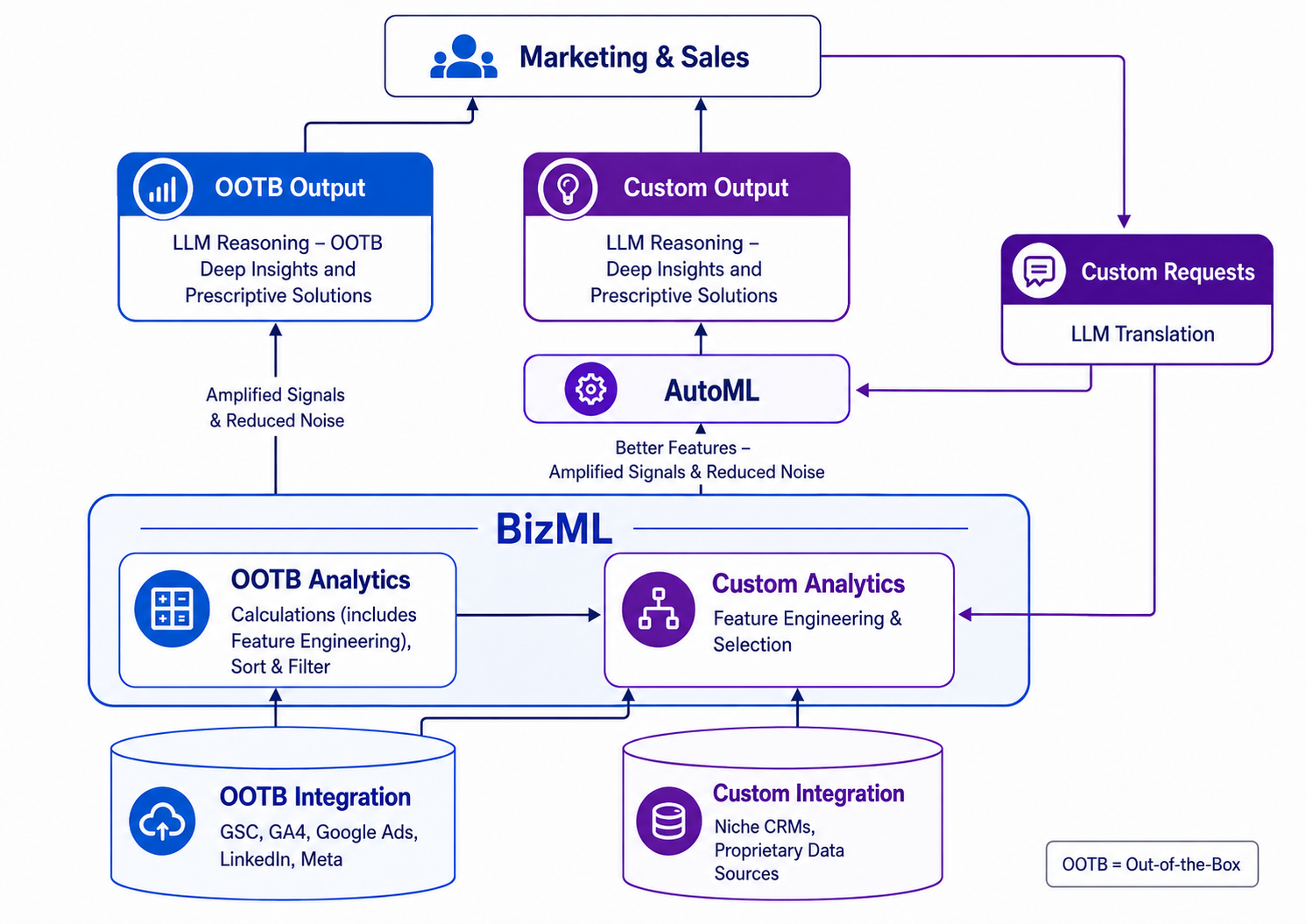
- Step 01 · Connect
Standard and custom integrations
Out of the box: GSC, GA4, Google Ads, and LinkedIn — read-only, revocable, no PII. Custom: niche CRMs and proprietary data sources integrate when the engagement calls for it.
- Step 02 · Compute
Standard analysis, tuned to your business
OOTB Analytics runs standard calculations — including feature engineering, sort, and filter — across the connected data. Custom Analytics extends this with feature engineering and selection specific to your business.
- Step 03 · Amplify
The patent-pending core
BizML's feature-engineering and selection methods boost the signals that matter and reduce the noise that misleads. Better features feed AutoML; better AutoML output feeds reasoning. This step is why the numbers downstream hold up.
- Step 04 · Reason
Plain language in, prescriptions out
An LLM reasoning layer turns the amplified output into deep diagnostic insights and prescriptive solutions. Custom requests arrive in plain language; the LLM translates them into analytics. No data-science background required — Semantic IQ is your data scientist, and BizML is the tool it uses.
Precise understanding, then prescriptive solutions.
ICP, personas, and buyer behaviour
Who your customers actually are and how they actually buy — real demographics, psychographics, and behaviour, computed from your data rather than assumed.
Website, SEO, social media, and ads
Not diagnostics alone. BizML-grounded reasoning produces prescriptive solutions across channels — what to change, where, and why the numbers support it.
Your data sources, integrated
Customer data beyond the standard connectors — niche CRMs and proprietary systems — joins the same analytics and reasoning pipeline.
Built for quantitative trading. Proven in production before it joined Semantic IQ.
BizML's feature-engineering and selection methods were first deployed where wrong numbers cost money immediately: quantitative trading and investing. It then moved into marketing — 15 production projects in total across both domains — before being embedded in Semantic IQ. The methods improve prediction accuracy, reduce error rates, and — just as importantly — increase explainability for the humans who need to trust the output.
+20%
Improvement in prediction accuracy when BizML features are used in predictive analytics.
Up to · vs. baseline features
−50%
Reduction in error rates on the same predictive tasks.
Up to · vs. baseline features
15
Production projects across seven customers — investing first, then marketing — before BizML was added to Semantic IQ.
Trading · advertising · churn
- November 2021
BizML emerges from a hedge-fund advisory project — feature engineering built for market data, where signal-to-noise is brutal and errors are expensive.
- April 2022
First advertising customer: a security SaaS company raises conversions by 700% after increasing marketing spend 7% to fund ads.
- 2022 onward
Applied across advertising, social media, influencer scoring, and churn prediction — 15 production projects for seven customers, with real GSC, GA4, Google Ads, and LinkedIn data, not only market data.
- Now
Added to Semantic IQ as its patent-pending core, within the Semantic Brain App — optimizing marketing first and sales next.
Semantic IQ is not possible without BizML. It is what turns raw data into signal — and signal into prescriptive insight.
See BizML work on your data.
Every demo includes a complimentary Audit IQ — a public business and technical audit of a target account before any access is required. If the account moves forward, connected data lets you quantify the leak, optimize spend, and prove outcomes.