
You can't optimize what you can't attribute. You can't attribute what isn't structured.
Audit IQ is the component within the Semantic Brain App that handles data quality. Not clean data for its own sake — data structured so attribution can be performed accurately, because only then can optimization be proven. It checks tracker hygiene before a contract exists, and adds API-level checks during and after onboarding: data quality throughout the journey.
We didn't plan to build an audit tool. The data made us.
Audit IQ came out of production work, not a product roadmap. Across customer engagements, the same discovery kept repeating: data quality was a big issue. Teams had more data than they could process in a lifetime — GSC, GA4, Google Ads, LinkedIn, Meta, the CRM — but it was fragmented across platforms, inconsistently tagged, riddled with tracking gaps, and rarely structured in a way that let anyone ask the questions that actually matter.
"Clean the data"
Cleaning treats data quality as a hygiene chore — dedupe, fix tags, move on. It produces tidier data that still can't answer the question that matters: which touch, which channel, which persona drove the outcome.
Structure the data for attribution
Audit IQ structures data so attribution can be performed accurately — trackers configured right, pipelines reconciled, events mapped to the journey. Only then can optimization be performed, and proven.
Every number downstream inherits the quality of this layer. Without it, attribution is an opinion wearing a confidence interval. With it, attribution becomes a measurement.
The foundation of an ordered stack.
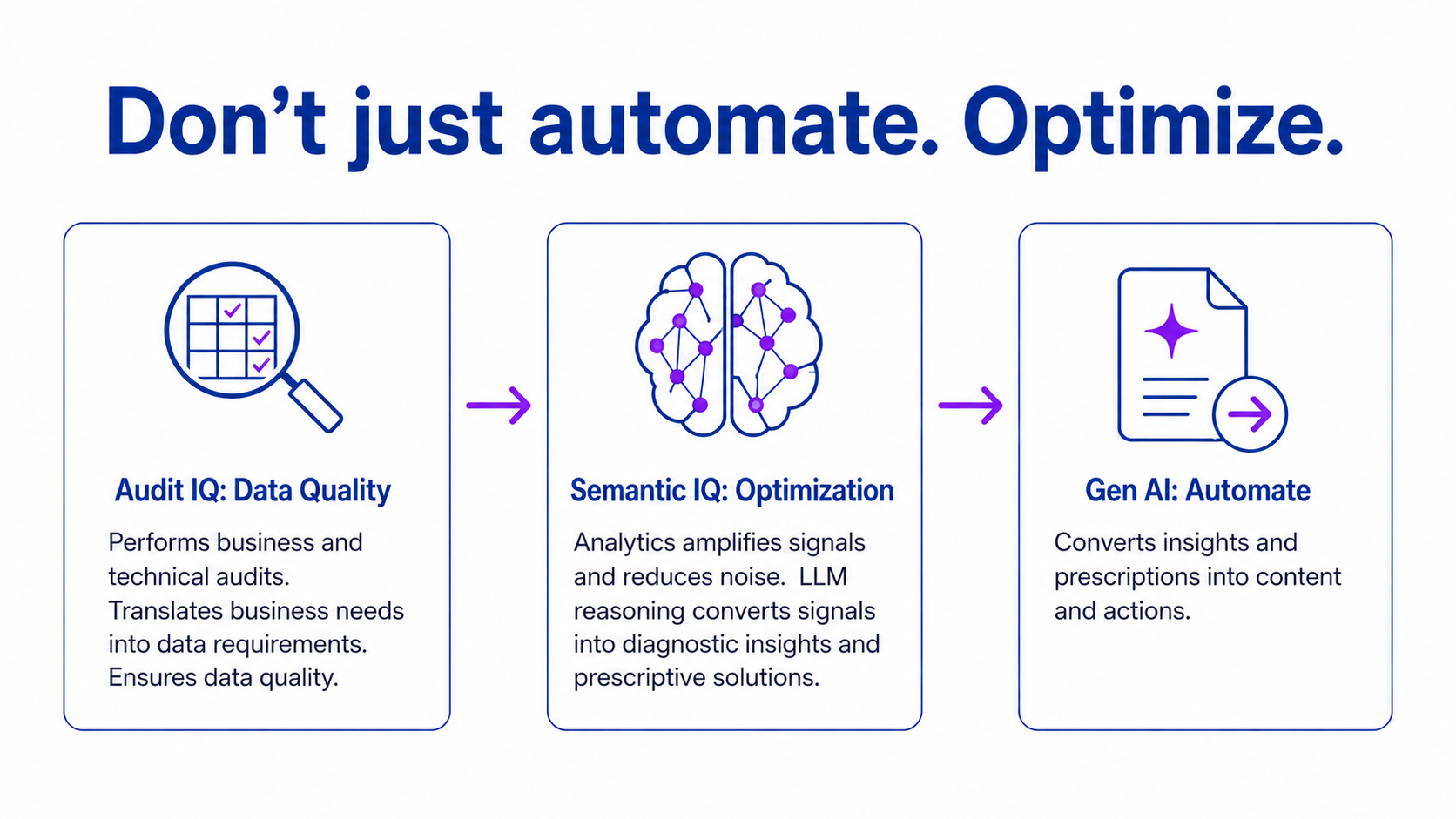
The order matters: data quality, then attribution, then optimization, then automation. Within the Semantic Brain App, Audit IQ is the foundation — it structures the data that Semantic IQ performs attribution and optimization on, and that Gen AI automates against. Skip this layer and every layer above it stops being trustworthy.
One engine, checking data quality at every stage of the journey.
Audit IQ is not a one-time onboarding scrub. It runs before a customer signs, while they onboard, and for as long as the engagement lasts — the checks deepen as access is granted, but the job never changes: keep the data structured so attribution stays accurate.
- Stage 01 · Pre-sales
Tracker hygiene, from the outside
Publicly available information only — no access granted, no API calls made. A business audit analyzes site content to identify marketing and analytics needs. A technical audit detects which trackers are deployed (GA4, LinkedIn Insight, Meta Pixel, MS Clarity, and others) and how they're configured. The output is a prioritized list of gaps, ready to discuss before any onboarding work begins.
- Stage 02 · Onboarding
Tracker hygiene plus API-level checks
With read-only, revocable access — no PII — Audit IQ adds API calls into GSC, GA4, Google Ads, and LinkedIn. It inspects the current state, recommends specific configuration changes with reasoning, and implements them — structuring the pipeline so the attribution baseline Semantic IQ establishes is accurate from day one.
- Stage 03 · Post-onboarding
Continuous governance
Tracker hygiene and API-level checks re-run periodically as the business runs. Regressions — a tag removed in a site update, a campaign misconfigured, a pipeline that quietly stopped reconciling — are caught before they corrupt the baseline and everything measured against it.
Pre-sales runs on public information only. API calls begin once read-only access is granted — and continue for the life of the engagement.
The same audit that fixes the pipeline opens the conversation.
Because the pre-sales audit works entirely from publicly available information, Audit IQ doubles as a prospecting and qualification instrument. It tells a sales team what's broken on a target account before the first call — and produces the artefacts to articulate it.
Run an audit before the first meeting
Outbound grounded in observed gaps rather than generic pitches. One-pagers and decks built from the audit output. Qualification scoring before reps spend cycles on the wrong accounts.
The instrument the sales pitch is built around
Agencies sell exactly what Audit IQ surfaces: sales, marketing, and data-pipeline gaps the prospect didn't know they had. It replaces hand-built audit decks that take days of analyst time, and converts directly into the scoped engagement on day one.
The audit that won the deal becomes the implementation plan that starts the engagement — no second discovery, no re-scoping.
Inspect. Recommend. Implement. Govern.
The current state, surfaced
Reads trackers from the outside pre-sales, and GSC, GA4, Google Ads, and LinkedIn via API once connected — and surfaces what's wrong.
Specific changes, with reasoning
Not a list of red flags — prescribed configuration changes, each with the reasoning that explains why it matters for attribution.
Changes applied to the pipeline
Fixes are applied against the pipeline, not left as a report — so attribution downstream is trustworthy, not aspirational.
Regressions caught early
Periodic re-runs of tracker hygiene and API checks catch regressions before they corrupt the baseline — continuous data governance.
Start with a free Audit IQ.
Every demo includes a complimentary Audit IQ — a public business and technical audit of a target account before any access is required. If the account moves forward, connected data lets you quantify the leak, optimize spend, and prove outcomes.