
The standard pitch for enterprise AI transformation is a deployment story. Count the agents. Count the automated workflows. Count the seats. The implied promise is that volume of deployment equals degree of transformation.
It doesn’t. The enterprises that pull off real transformation are not the ones with the most agents. They are the ones whose learning rate goes up — the ones that turn every deal, every campaign, every experiment into accurate, reusable knowledge faster than their competitors. Agents are a tool. Learning velocity is the thing that compounds.
This is a follow-up to our last post, Personal memory makes agents helpful. Institutional memory makes companies compound. That piece drew the line between two kinds of memory: the personal memory that makes a single Gen AI agent useful in the moment, and the institutional memory that lets a company accumulate knowledge across people, teams, and time. The argument held that institutional memory is what allows a business to compound rather than restart.
Here is what that adds up to. Institutional memory does more than record — it already accelerates learning. A company that captures what worked, where, and why, and makes it available across teams, reaches better outcomes faster than one that starts from scratch each time. Faster learning is possible because of memory, not in spite of it. That is the baseline gain, and it arrives before any change to how the business operates.
The next gain comes from building on it. An organization that makes learning an explicit priority — people getting sharper alongside the system, not just the system running on its own — compounds the advantage further. Memory sets the pace of learning. A learning culture raises it. In a market shaped by AI, speed is the success factor, and Institutional Memory is what makes that speed possible.
Two growth curves, not one
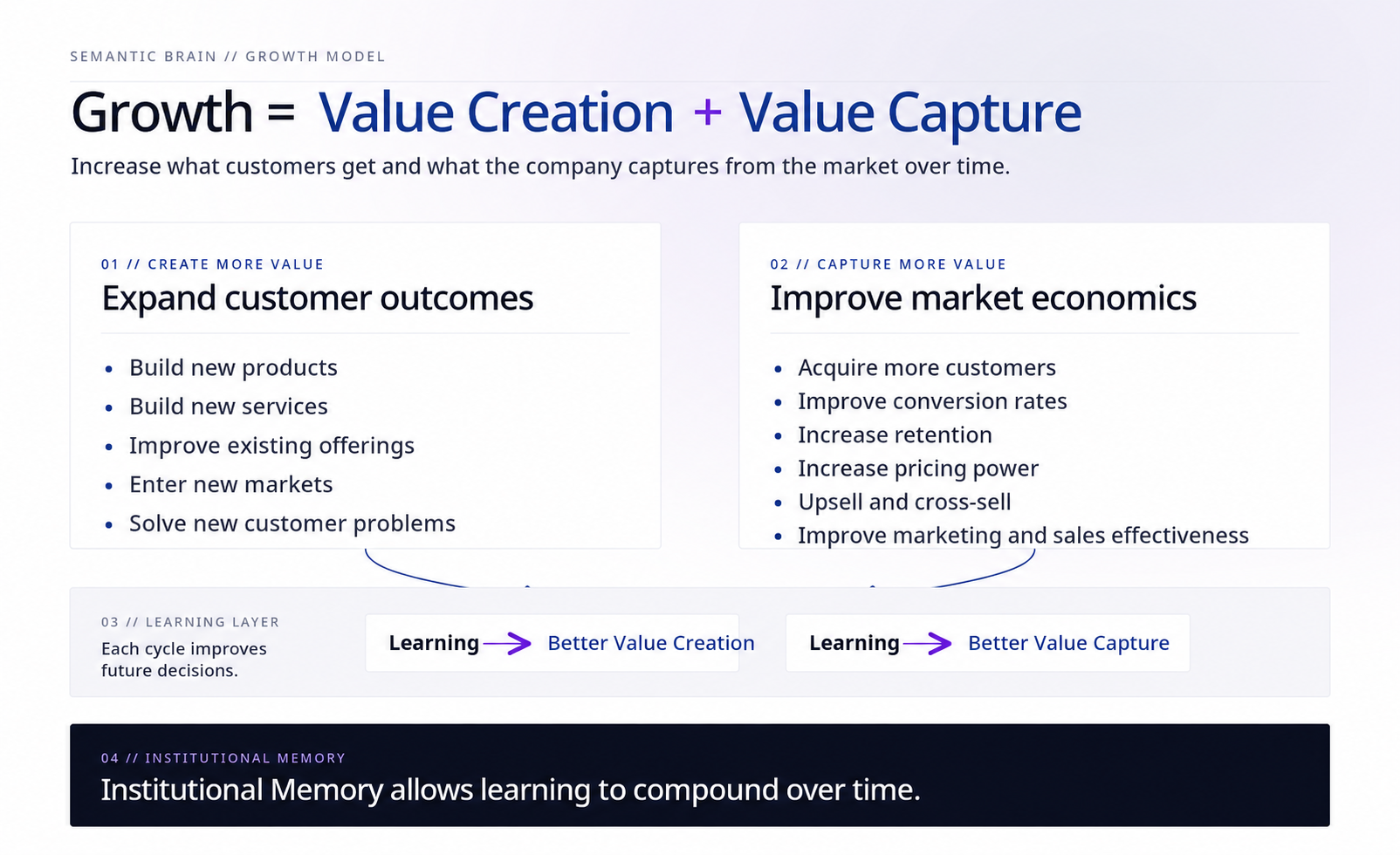
Growth is two things at once: the value you create for customers and the value you capture from the market. You expand customer outcomes — new products, new services, new markets — and you improve market economics — conversion, retention, pricing power, sales effectiveness. Both sides get better when the organization learns, and Institutional Memory is what lets that learning compound across cycles instead of resetting each time.
Most companies track a single curve: revenue and profit. It is the curve the board cares about, and it should be.
There is a second curve underneath it that almost nobody tracks: learning growth — the rate at which the organization turns activity into knowledge it can reuse. The two are not independent. When learning growth is flat, business growth gets more expensive every quarter, because each new dollar of revenue costs about as much to earn as the last one did. When learning growth rises, future business growth gets cheaper, because the company already knows what works and stops paying full price to relearn it.
Growth without learning growth stalls. Not immediately — you can buy revenue for a while — but the margin erodes and the curve eventually flattens, because nothing underneath it is improving. Learning growth is what keeps the revenue curve from going flat.
The constraint is margin
Accelerating learning is easy if you are allowed to spend. Hire more people. Run more pilots. Push more live experiments into market. Every one of those buys faster learning, and every one of those costs money.
The discipline — the part that matters to an enterprise — is accelerating learning while holding cost flat. Faster learning that erodes margin is not a transformation. It is a more expensive way to operate.
This is where most AI programs quietly lose money. Pointing Gen AI agents at raw data feels like progress, but it is faster, not cheaper — token costs climb with every query against messy, unattributed data, and the answers are only as good as the inputs. Automation applied too early scales the cost of confusion. As we argued in The limits of AI automation: don’t jump straight into automation — clean the data and perform attribution first. And as we covered in Gen AI agents can’t optimize: Gen AI is not a calculator. You need Analytics to do the calculation. Learning that compounds margin runs on measured inputs, not raw ones.
Learning has to be quantitatively accurate
Most organizational “learning” is anecdote — a war story from a closed deal, a retro nobody revisits, a slide that confirms what someone already believed. Anecdote does not compound. It accumulates, contradicts itself, and decays.
Accelerated institutional learning has to clear a higher bar. It has to be quantitatively accurate: measured, attributable, and repeatable. If you cannot measure the lesson, you did not learn it — you formed an opinion. This is why the work starts with Audit IQ ensuring data quality and Semantic IQ performing attribution and driving optimization before anything gets automated. You cannot accelerate learning you cannot measure. You can only accelerate the speed at which you fool yourself.
How to accelerate without adding cost
If the constraint is margin and the requirement is accuracy, the methods follow.
Simulate before you commit. B2B sales cycles are long, expensive teachers. You learn what actually works only after months of live deals, and you pay full price for every lesson. Simulations with synthetic personas change the economics: you rehearse the sales cycle against modeled buyers, test approaches, and compress months of live learning into low-risk iterations before any real budget moves. Start there, then graduate to first-party data once the model has direction. Simulation gives you speed and safety early; first-party data gives you accuracy as it arrives. This capability is close, and it moves where the learning happens — into rehearsal, not only production.
Use ads as a learning instrument. Paid media in B2B and B2C is usually budgeted as demand generation. It is also one of the fastest sources of attributable signal you can buy. A well-instrumented campaign returns measured response in days, not quarters, which cuts learning time directly. Treated as an experiment rather than only a spend, advertising becomes a way to learn fast and cheaply about what the market actually responds to.
Keep the risk low at every step. The through-line in both methods is the same: simulate before you commit, measure before you scale. Low-risk learning is what lets you accelerate without betting the margin on every lesson.
The loop is the product
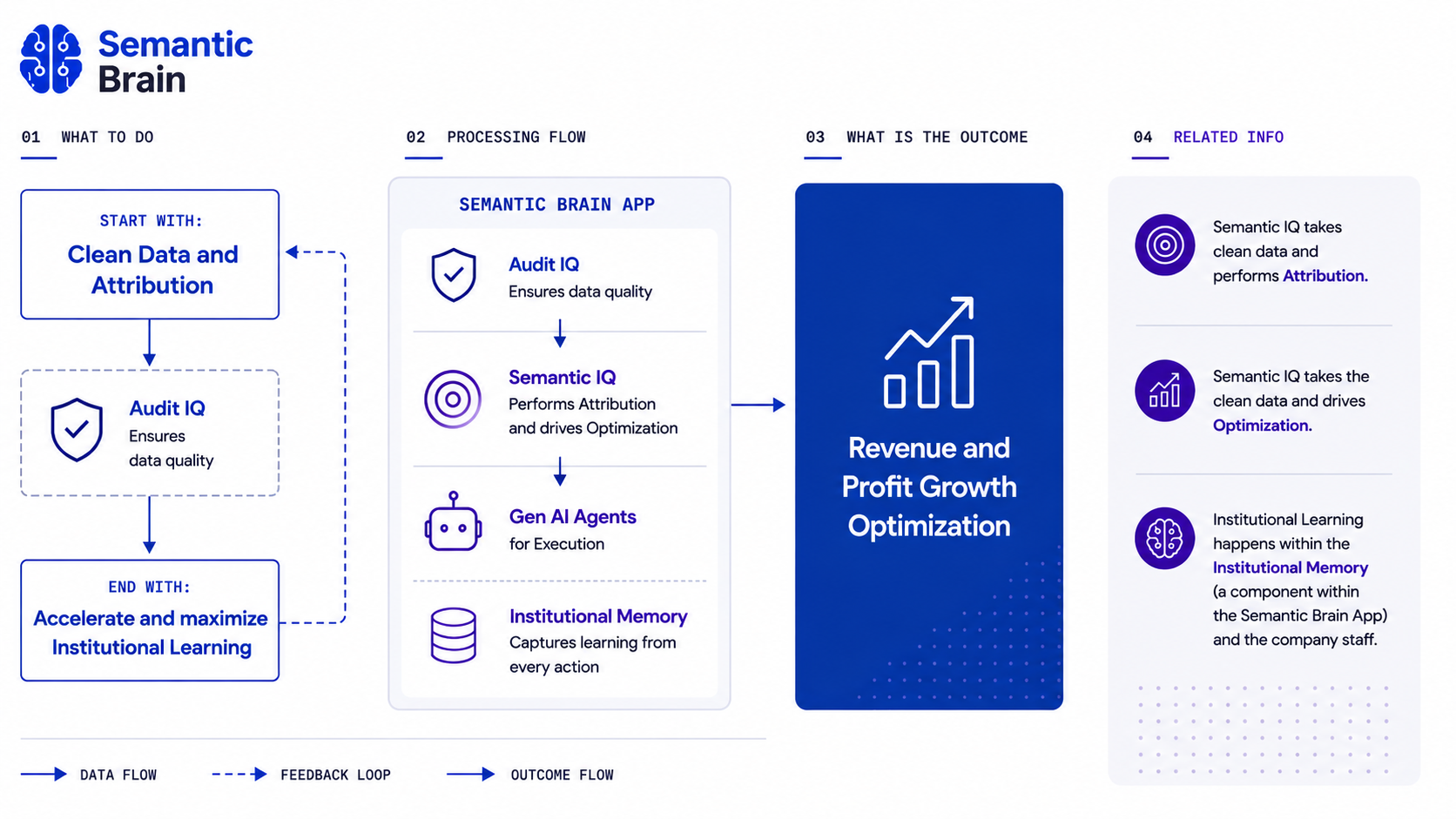
Look at how the pieces connect. Clean data and attribution at the start. Audit IQ ensures quality. Semantic IQ runs attribution and drives optimization, with BizML underneath it. Gen AI agents handle execution. Institutional Memory captures the learning from every action — and feeds it back to the start. The outcome is revenue and profit growth optimization.
The real output of that loop is not any single optimized campaign. It is a faster loop. Institutional Memory is what makes each turn start ahead of the last — and start faster, because the system is not relearning what it already knows. Add a deliberate emphasis on learning, with people getting sharper alongside the system, and the loop tightens further: each turn runs faster than the one before, at lower cost than the one before. Memory makes the acceleration possible. A learning culture extends it.
What transformation actually means
AI transformation sold as a count of agents is a tooling upgrade dressed as a strategy. Real transformation is a change in learning rate — and you can see it in the outputs an enterprise budgets for: more products, faster go-to-market, lower overhead per launch. Those are not the results of owning more automation. They are the results of an institution that has learned how to do the work and keeps learning how to do it faster, without spending more to learn.
Don’t just automate. Optimize — including the rate at which you learn.
The question for next quarter is not how many agents you deployed. It is whether you will learn faster than you did this one.