
Optimization is a calculation problem before it is a reasoning problem.
Semantic IQ is the component within the Semantic Brain App that handles attribution and optimization. Machine Learning does the computation, sorting, and filtering; an LLM reasons on the amplified signal. The output is deep diagnostic insights and prescriptive solutions — grounded in attribution you can trust, requested in plain language.
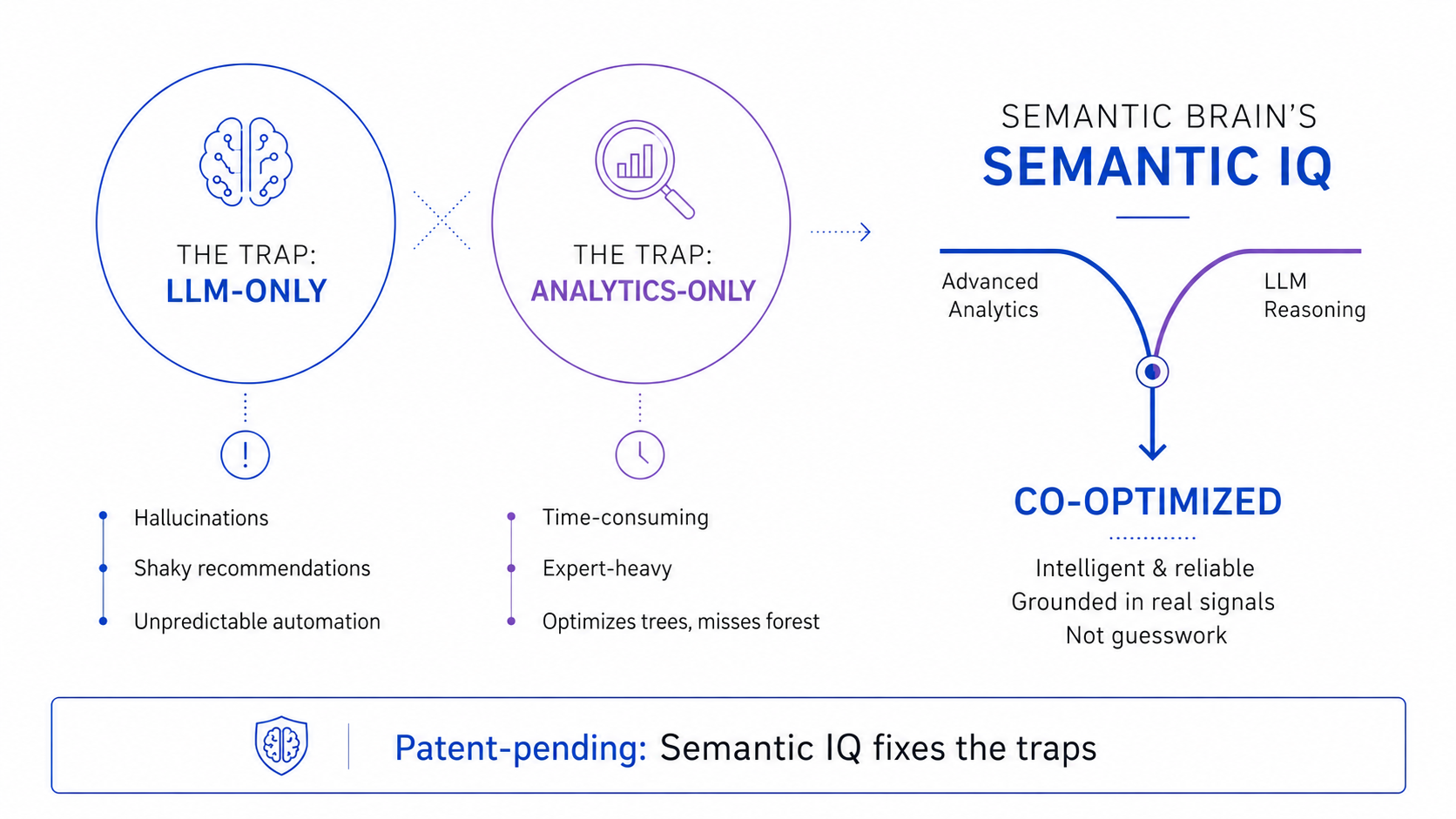
Gen AI agents alone can't optimize. Pure Analytics alone can't prescribe.
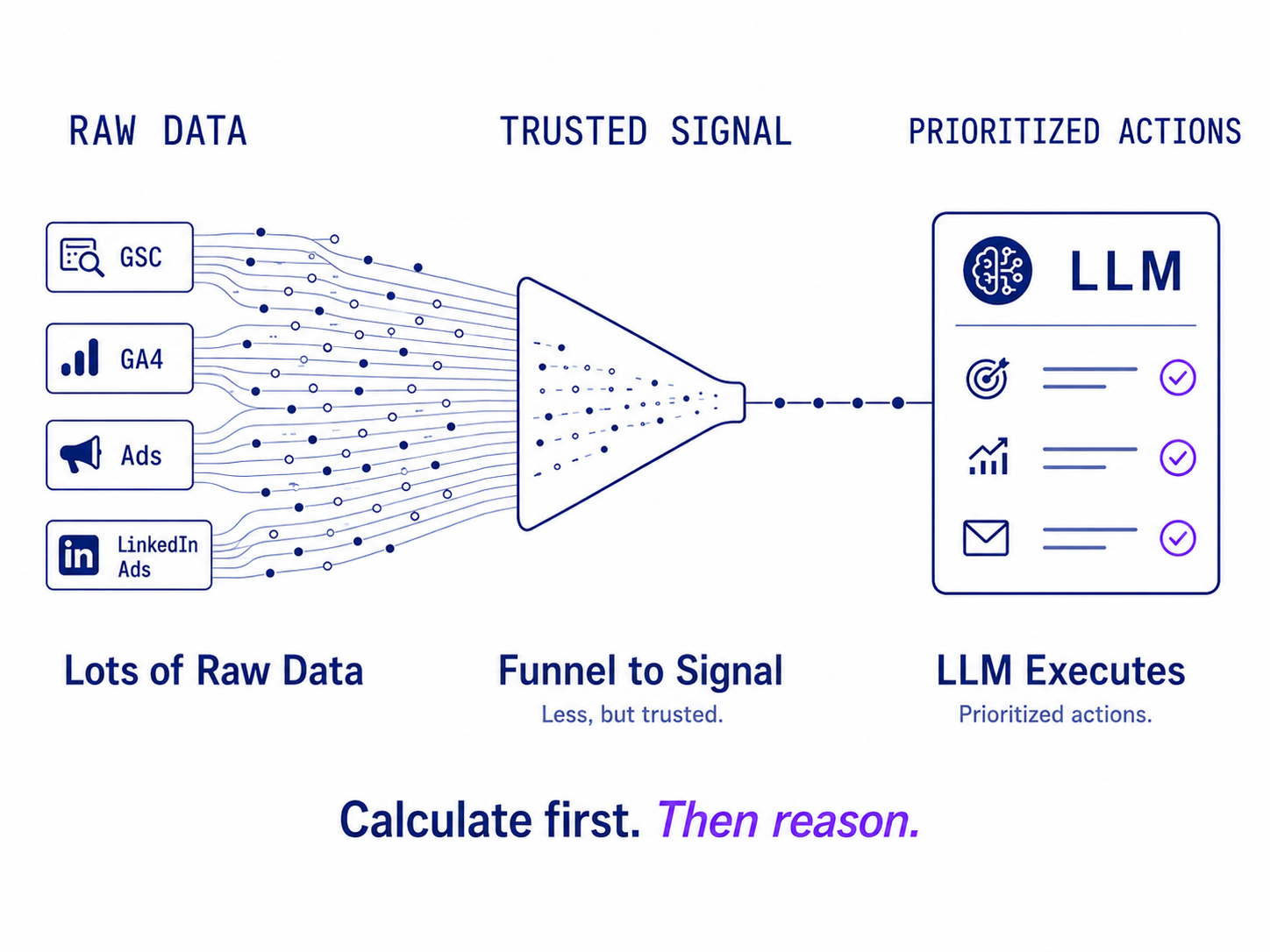
Point a Gen AI agent at raw GSC, GA4, Google Ads, LinkedIn, or Meta data and it hallucinates, runs up token cost, or stalls at first- and second-order reporting — conversion rate by age group, age groups ranked by conversion rate. The work that moves performance sits one or two orders above that. Skip Gen AI and run pure Analytics instead, and you get predictions without causes: a churn probability, but not what drives it or what to do about it.
Reasoning asked to do a measurement job
LLMs are not calculators. Asked to do arithmetic and reasoning at once across tens of thousands of records, the model produces confident fiction. The confidence is the problem.
Prediction without prescription
Machine Learning on its own is time-consuming, expert-heavy, and mute on cause. It optimizes individual trees and loses the forest — and the models usually need more history than the company has.
Optimization at scale requires both. Not glued together — co-optimized. Compute the signal first. Reason on the signal second. The order of operations is the whole game.
One layer in an ordered stack.
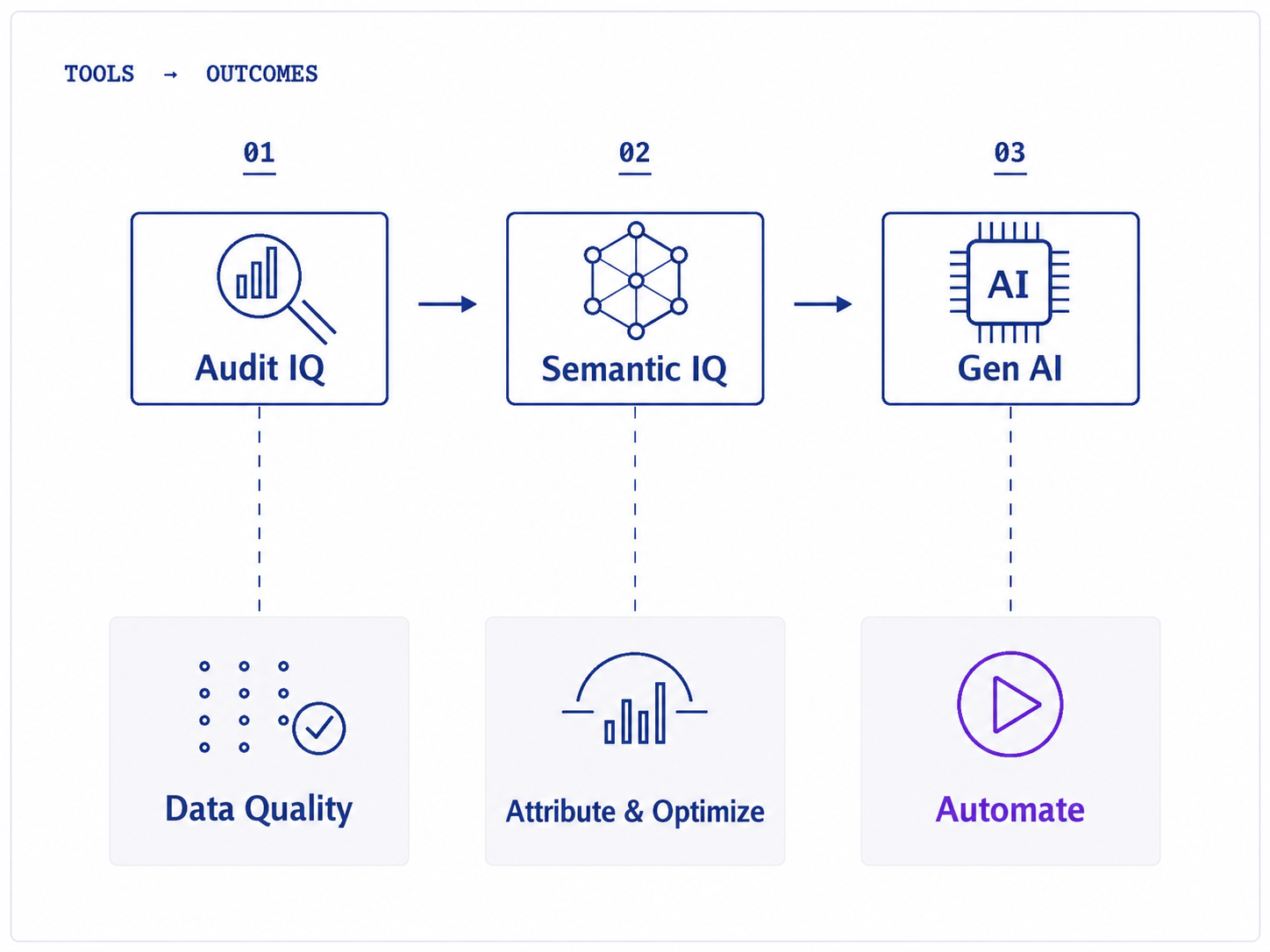
The order matters: data quality, then attribution, then optimization, then automation. You cannot prove optimization without attribution. You cannot do attribution without clean, reconciled data. Within the Semantic Brain App, Audit IQ handles data quality. Semantic IQ handles attribution and optimization. Gen AI sits on top and automates the prescribed action. Skip a layer and the layer above it stops being trustworthy.
Machine Learning computes. The LLM reasons. Neither does the other's job.
Semantic IQ splits the work along the line that matters. Instead of asking a model to reason across 10,000 or 100,000 records, BizML reduces the input to the few hundred records that carry the signal. Compute cost drops. Processing time drops. The hallucination rate drops because the model is no longer asked to do arithmetic.
- Step 01 · Baseline
Attribution established at onboarding
Working from connected GSC, GA4, Google Ads, and LinkedIn data — read-only, revocable, no PII — Semantic IQ establishes reliable attribution and a performance baseline. Every claim of improvement is measured against it.
- Step 02 · Scan
Continuous signal detection
The baseline is continuously scanned for signal across channels and campaigns — causal attribution across paid and organic, persona-level movement, cohort drop-offs at specific steps.
- Step 03 · Amplify
BizML separates signal from noise
The patent-pending core. Feature-engineering and selection methods boost the signals that matter and reduce the noise that misleads, cutting the input to the records that carry information. This step is why the numbers downstream hold up.
- Step 04 · Reason
Plain language in, prescriptions out
An LLM reasoning layer turns amplified signal into deep diagnostic insights and prescriptive solutions. Eliminate the ineffective keywords in this campaign. Address these missed SEO opportunities. Generate these three ad variants for this Persona. No data-science background required.
Semantic IQ is not possible without BizML.
BizML is the patent-pending Machine Learning engine within Semantic IQ. Its feature-engineering and selection methods were first deployed where wrong numbers cost money immediately — quantitative trading and investing — then applied to marketing across 15 production projects before being embedded here. It is what turns raw data into signal, and signal into prescriptive insight.
+20%
Improvement in prediction accuracy when BizML features are used in predictive analytics.
Up to · vs. baseline features
−50%
Reduction in error rates on the same predictive tasks.
Up to · vs. baseline features
15
Production projects across seven customers — investing first, then marketing — before BizML was added to Semantic IQ.
Trading · advertising · churn
Read the full BizML story — provenance, data flows, and the technical proof →
First the truth. Then the prescription.
ICP, personas, and buyer behaviour
Who your customers actually are and how they actually buy — real demographics, psychographics, and behaviour, computed from your data rather than assumed.
Attribution tied to cause
Causal attribution across paid and organic, and persona-level diagnosis of why a cohort drops at a specific step — measured against the baseline established at onboarding.
Next-best-action under real constraints
Prescriptive solutions across website, SEO, social media, and ads — what to change, where, and why the numbers support it, within the budget you already have.
See Semantic IQ work on your data.
Every demo includes a complimentary Audit IQ — a public business and technical audit of a target account before any access is required. If the account moves forward, connected data lets you quantify the leak, optimize spend, and prove outcomes.