
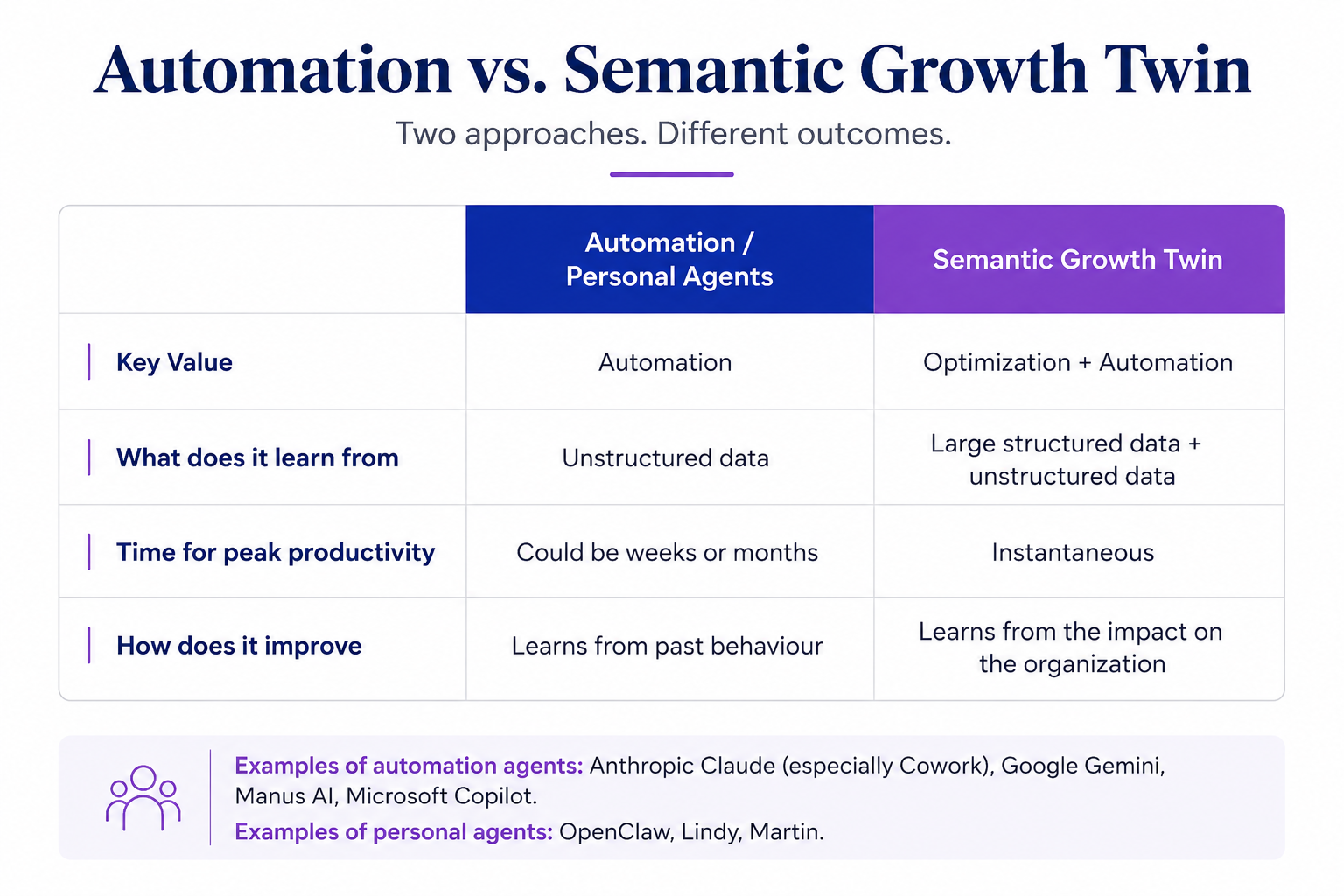
If you want personal productivity, traditional agent memory works. If you want to optimize company growth, you need institutional memory.
The two are easy to confuse because they share a word. A conventional Gen AI agent builds memory from its interactions with you. It learns your phrasing, your preferences, the way you like a report laid out. That memory is real, and for personal productivity it is enough — the agent gets easier to work with every week.
But the thing it remembers is you. Not the company. Not which campaigns returned and which quietly drained budget for three quarters. Not why a channel that worked last year stopped working. The operator’s habits are in the model; the operation’s history is not. For an individual, that is a fair trade. For a company trying to compound growth, it is the wrong memory entirely.
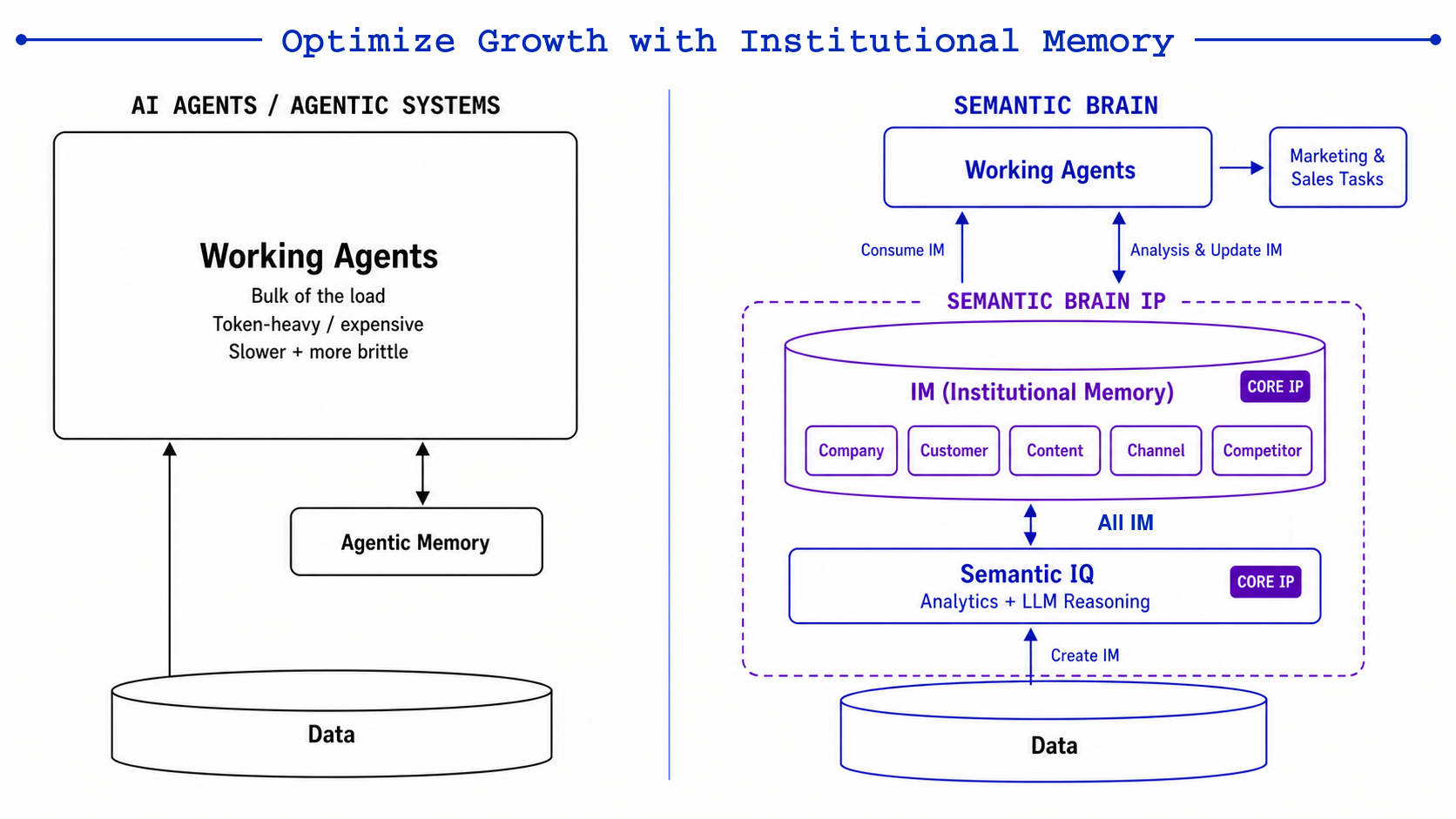
Institutional memory is the alternative. It learns from an organization’s past performance across its digital channels — and from how the organization actually uses the Semantic Brain App over time. The unit of learning is the company, not the seat.
The data is already good. The reasoning is the problem.
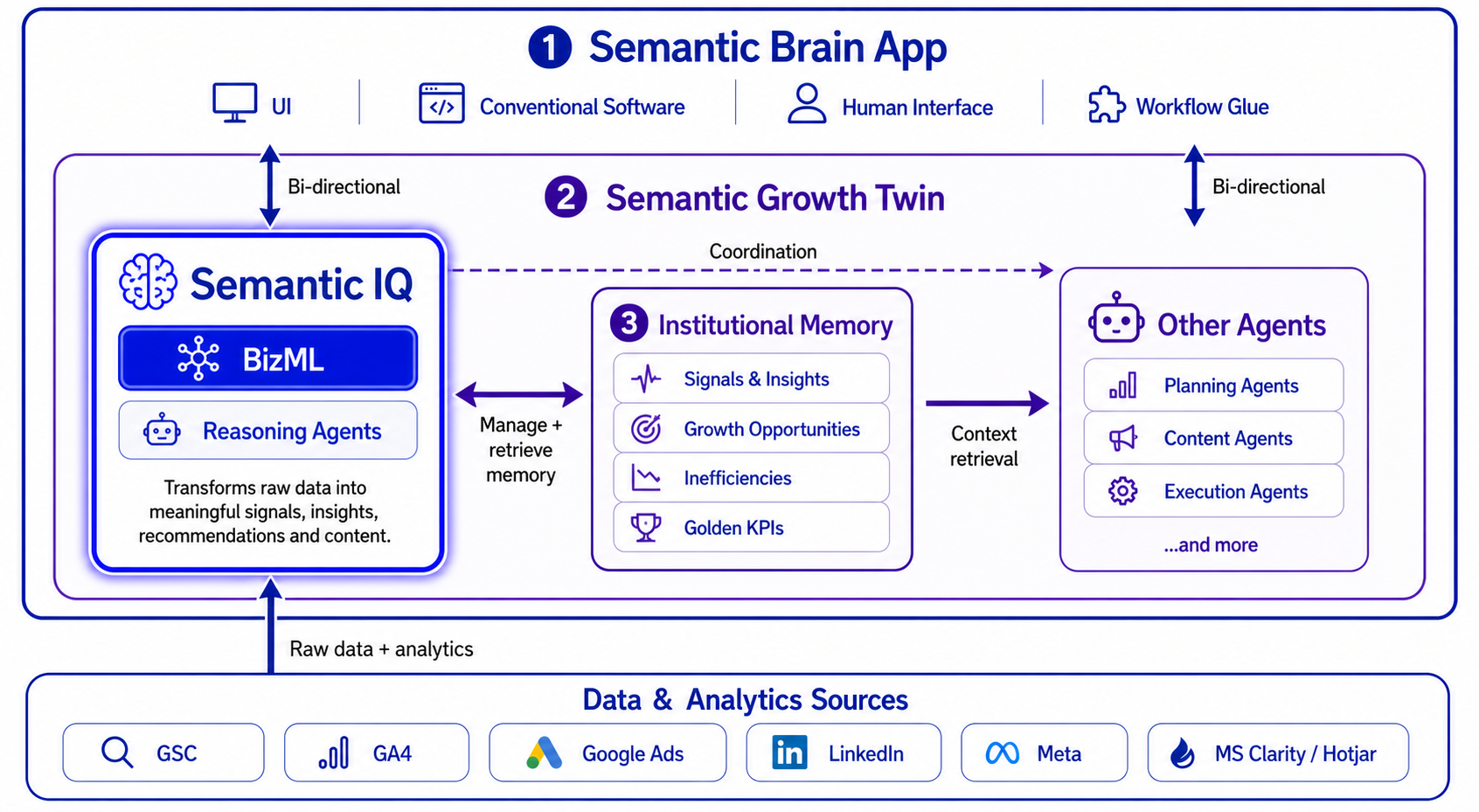
Google, LinkedIn, and Meta already publish data more than adequate for marketing and sales optimization. The constraint has never been raw signal. The constraint is what happens between the signal and the decision.
Feed that data straight into an LLM and two things break. The reasoning hallucinates, because the model is pattern-matching across noise it has no way to weight. And the cost runs away, because every query and every row is paying for tokens.
Semantic IQ sits in that gap. Inside it, BizML — our patent-pending engine, originally built for quantitative trading — does the work an LLM should never be asked to do. It amplifies signal and reduces noise. It runs the calculations, the sorts, the filters. Only then does it hand a structured result to the LLM for reasoning.
The output is two things at once: deep diagnostic insight into what is happening, and prescriptive solutions that are quantitatively optimal rather than merely plausible. The mechanism matters. An LLM reasoning over pre-structured analytics produces a defensible answer. An LLM reasoning over raw exports produces a confident one.
It is also far cheaper. In areas such as analyzing search and ad queries, pre-structuring with BizML can cut LLM token consumption to as little as one-hundredth of the naive approach. That is not a rounding error. It is the difference between an analysis you run continuously and one you run once a quarter because the bill hurts.
Why memory has to be institutional
Memory is a load-bearing component for any serious agent. The question is whose memory, and of what.
A conventional agent’s memory is a record of interactions — useful, but bounded by the person it happens to be sitting with. We built for a different unit. The Semantic Brain App’s memory is the organization’s performance history: what its channels did, what its customers responded to, what worked and what was waste, accumulated and carried forward. It also learns from usage. The more the App runs against a company’s data, the sharper its baseline becomes.
This is the difference between an assistant that knows you and a system that knows your business.
The Semantic Growth Twin
Institutional memory needs somewhere to live. For us, that is the Semantic Growth Twin.
It rests on one premise: there is a fundamental performance gap between a system taught to mimic existing behaviour and a system that understands what worked, what didn’t, and why. The first inherits a ceiling — it can only reproduce the patterns it was shown. The second compounds, because every cycle adds to what it understands. Over time, those two paths separate, and they do not reconverge.
The Growth Twin mirrors a company’s entire ecosystem: the company, its customers, and — where it matters — its competitors. It is not a digital twin in the usual sense. It is not a replica. A replica tries to copy everything; the Growth Twin keeps only what changes outcomes. It persists growth signals and waste signals, holds them in compressed form, and tracks progress against them. What it remembers is the part that moves the number.
The 5Cs: what the memory is organized around
Signal is only useful when it is structured. The Semantic Growth Twin organizes what it remembers around five categories — the 5Cs.
Company. The business itself: its products and services.
Customer. For B2C, customer segments defined by demographics (age, gender, household income) and psychographics (affinity and in-market intent). For B2B, sector, industry, account, and the firmographics that describe them.
Content. Which content and topics are working — what customers search for, and what they actually engage with once they arrive.
Channel. SEO, social, and paid — and not just the channel type but the specific channel: LinkedIn, YouTube, Instagram, TikTok, each with its own behaviour.
Competitors. Direct, indirect, and alternatives — the options a customer weighs instead of you.
Why the 5Cs are enough
The claim, stated plainly: once you hold the growth signals and the inefficiency indicators for all five Cs, you can address nearly every marketing and sales use case — optimally. The coverage is not partial. Acquisition, retention, channel mix, content strategy, segmentation, competitive positioning — they all decompose into questions about those five categories.
The reach extends past marketing, too. Many product-management questions on the business side — what to build, for whom, against which alternative — are answerable from the same structured memory.
That is the case for institutional memory over personal memory. A personal agent makes one operator faster. Institutional memory, organized around the 5Cs and carried by the Semantic Growth Twin, makes the company itself better at the thing it is trying to do. One is convenience. The other compounds.