
Nearly half of all Gen AI agent activity is software engineering. Anthropic measured agent autonomy on its API using tool calls as a proxy, across roughly one million tool calls. Software engineering accounted for 49.7% of them. Back-office automation was a distant second at 9.1%. Marketing and copywriting came in at 4.4%, and sales and CRM at 4.3%.
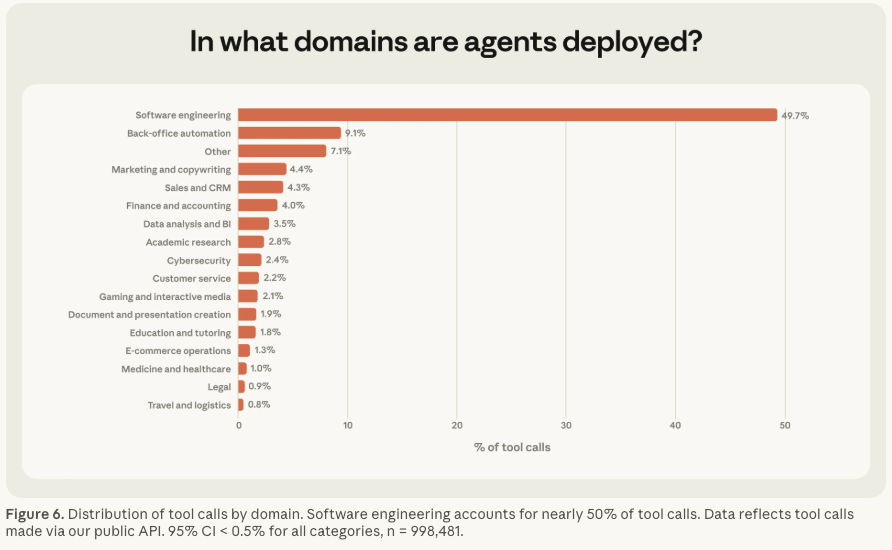
Source: https://www.anthropic.com/research/measuring-agent-autonomy
Demand does not explain the gap. In OpenAI’s consumer data, writing holds the number one spot among work-related chatbot messages at roughly 39%, and its multimedia share has grown. Technical help is fourth and declining — from about 21% of work-related messages in mid-2024 to under 9% today.
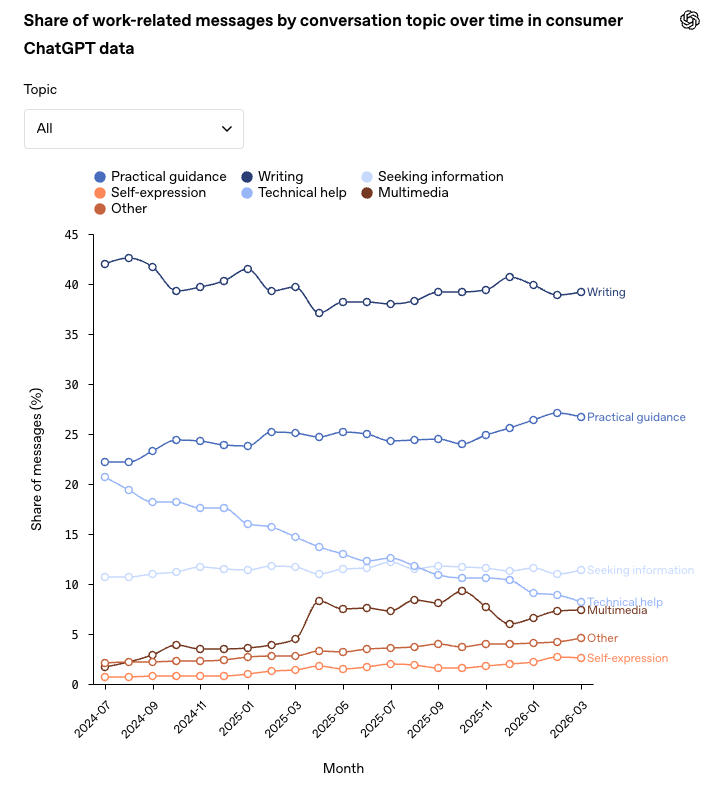
Source: https://openai.com/signals/data/
Across all chatbot messages, technical help sits at the bottom of the topic list.
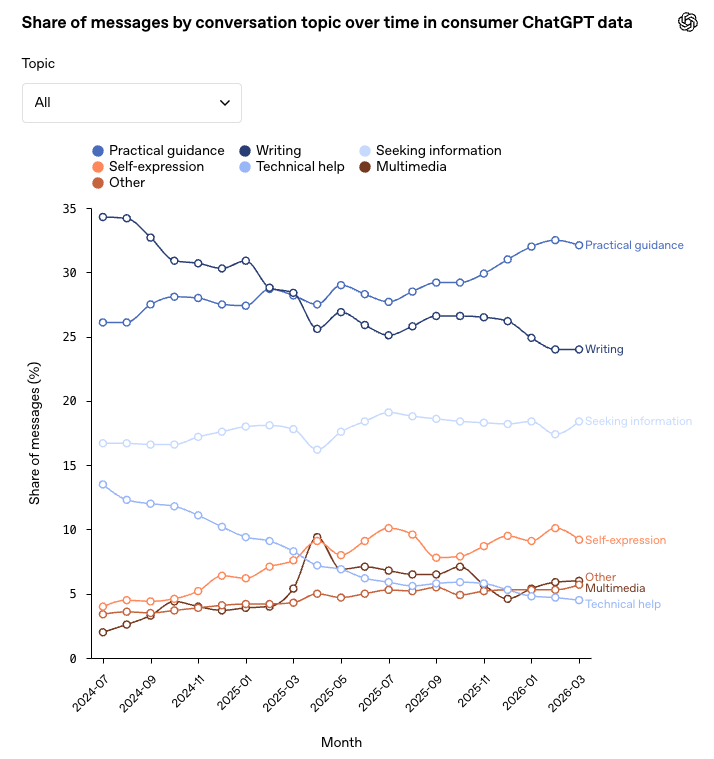
Source: https://openai.com/signals/data/
If chatbot usage predicted agent adoption, marketing and sales would be leading agent deployment. They are not.
“The models are better at coding than at writing” is not a good explanation either. The same models that ship production code write the marketing copy that ranks first in message share.
The difference is the harness
The difference is not the model. It is the harness — the workflow and the evals wrapped around the model.
The coding agent workflow:
- Interpret the task and break it down.
- Gather context: the code, the tests, the docs, sometimes the tickets.
- Plan the changes.
- Make the changes.
- Run the tests, or write new ones.
- Check the results. If it fails, iterate.
The evals are unambiguous: does it compile, and do the tests pass. The goal, the context, and the pass/fail signal all live in the repository. Coding is primarily an automation exercise.
The repository provides one more thing: memory. Every fix, test, and design decision accumulates in one place, so the agent’s context compounds with each task. Marketing has no repository. Unless something accumulates what worked, what failed, and why, every campaign starts from zero.
Marketing and sales need a different harness
Marketing and sales do not fit that template, for five reasons:
- The goal is not to produce content or documents. The goal is to improve marketing and sales efficiency and growth.
- The context is not sitting in one repository. It comes from humans and from content and structured data across GSC, GA4, Google Ads, LinkedIn, and similar sources.
- Optimization is not possible without attribution. Without knowing what drove results, there is nothing to optimize against.
- Even after attribution, LLMs cannot optimize. LLMs are not calculators. Analytics and Machine Learning are a requirement.
- Humans need to be part of the eval. There is no compiler for a positioning decision, so this is human in the loop — and areas with no data available for optimization analysis should remain human-led.
Automation-centric vs. growth-centric
The automation-centric approach works for coding, and for a handful of other domains where the tasks have stayed limited in complexity. Everywhere else, success still requires a harness — workflows and evals — but the harness needs to be growth-centric: built around attribution, analytics, and human judgment rather than around a compiler.
What this means for operators
When a vendor pitches a marketing or sales agent, ask two questions. What is the eval? And where does the attribution come from? If the answer to either is “the model is very good,” you are looking at an automation harness dressed as a growth tool. The model was never the constraint.
This is the premise behind the Semantic Brain App. Semantic IQ is the growth-centric harness for marketing: it establishes attribution from your connected data, applies Machine Learning to optimize against it, and keeps humans in the eval loop. BizML, the patent-pending Machine Learning engine inside Semantic IQ, improves predictive accuracy by up to 20% and reduces error rates by up to 50%. The order is deliberate — attribution then optimization before automation.