
GA4, Google Search Console, Google Ads, LinkedIn, Meta — the structured data sitting in these platforms is some of the most operationally useful data a company owns. The current consensus on how to extract value from it: point a Gen AI agent at it and let the agent reason its way to a recommendation.
This does not work. Or rather, it works for a narrow class of problems and breaks on everything that matters. The reason is simple. LLMs are not calculators. Optimization is a calculation problem before it is a reasoning problem. Hand the calculation to the wrong tool and the reasoning that follows is fiction.
We have watched three versions of this mistake play out.
Approach one: throw the data at the LLM. Tens or hundreds of thousands of records go straight into the context window, depending on company size. Compute cost is high. Processing is slow. The signal-to-noise ratio is bad. Because the model is asked to do arithmetic and reasoning at once across a long input, the outputs hallucinate and the recommendations are shaky. The agent is confident. The confidence is the problem.
Approach two: have the LLM generate the analytics code. This is an improvement. Code is the right venue for compute. But the code an agent produces in practice rarely gets past first- and second-order descriptive analytics. First-order looks like “conversion rate by age group.” Second-order is “rank age groups by conversion rate.” That is reporting, not optimization. The work that actually moves performance — causal attribution across paid and organic, persona-level diagnosis of why a cohort drops at a specific step, prescriptive next-best-action under budget constraints — sits one or two orders of analytics above what coding agents reliably produce.
Approach three: bolt on a marketing framework. AIDA, DAGMAR, and similar frameworks give the agent a lens for content analysis. The lens is real. The problem is that AIDA and DAGMAR were not designed against the structured data that GA4, GSC, Ads, LinkedIn, and Meta actually emit. Stretched over that data they produce category-level commentary, not precise reads on Customer Persona or Buyer Behaviour. Useful as a teaching tool. Insufficient as an optimization layer.
The pattern that fixes all three looks like this.
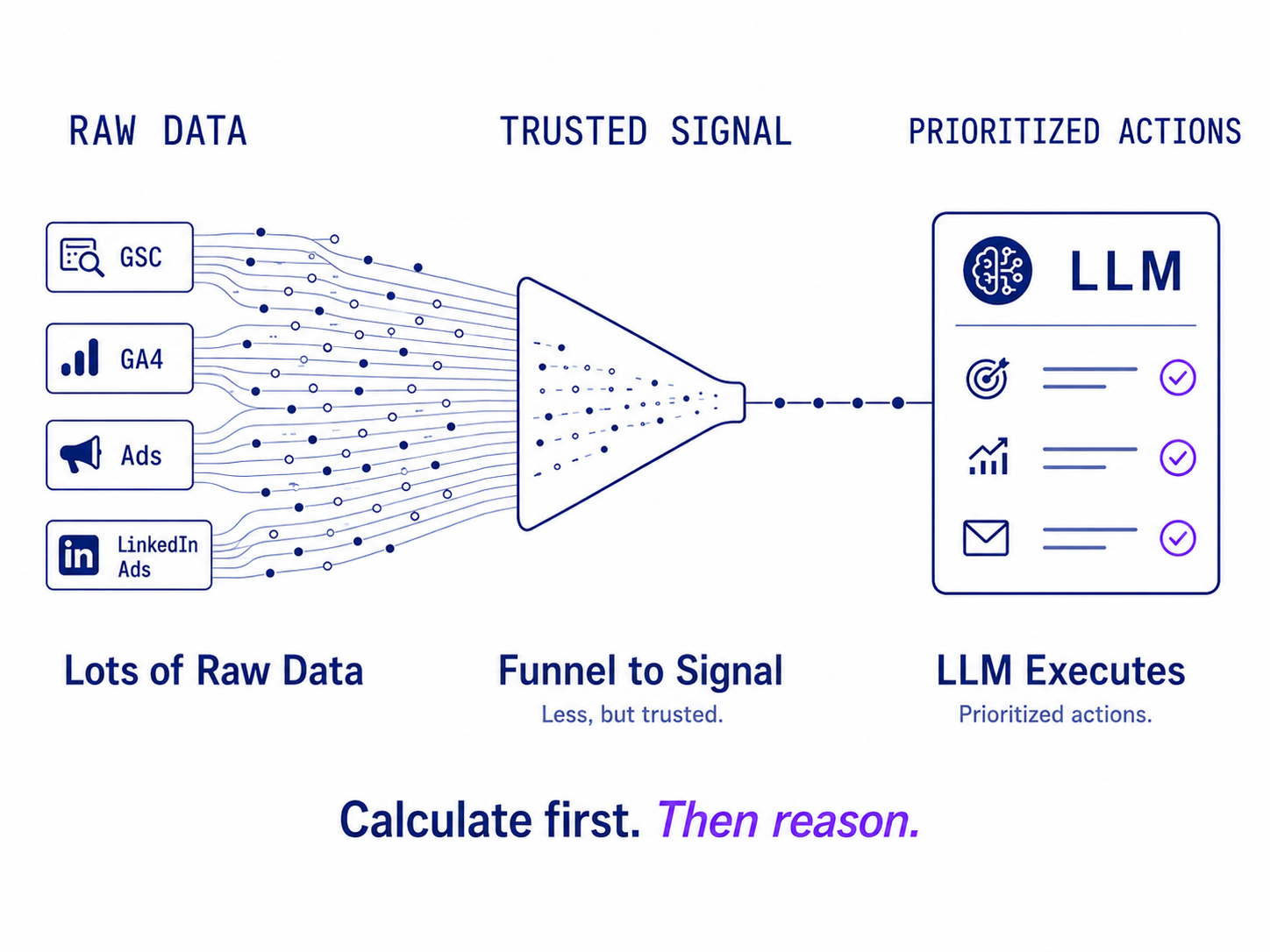
Compute the signal first. Reason on the signal second. The order of operations is the whole game. We will get to the mechanics. First, the other failure mode.
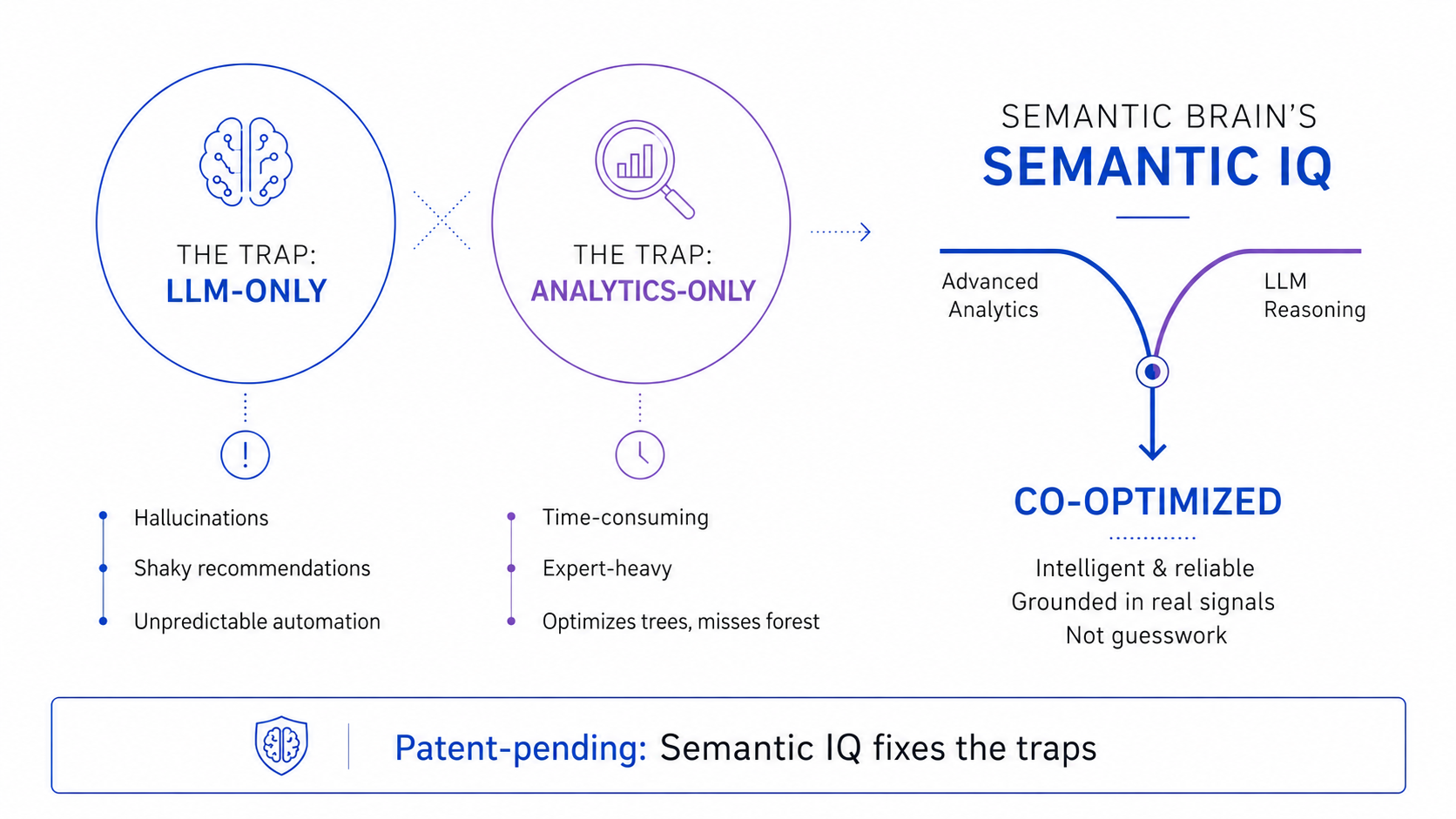
The reaction to LLM-only failure is often: skip Gen AI, hire analysts, run pure Analytics. That has its own failure mode. Pure Analytics is time-consuming and expert-heavy. It is good at predicting — Machine Learning will give you a churn probability — without telling you what is causing the churn or what to do about it. It optimizes individual trees and loses the forest. And the high-accuracy predictive models that justify the headcount usually need more historical data than the company has.
Optimization at scale requires both. Not glued together — co-optimized. Semantic IQ, the component inside the Semantic Brain App that handles this, splits the work along the line that matters: Machine Learning does the computation, sorting, and filtering. The LLM does the reasoning on the filtered output.
The numbers shift accordingly. Instead of asking a model to reason across 10,000 or 100,000 records, BizML — the patent-pending engine inside Semantic IQ — reduces the input to the few hundred records that carry the signal. Compute cost drops. Processing time drops. The hallucination rate drops because the model is no longer asked to do arithmetic. What comes out the other side is closer to diagnostic insight and prescriptive solution than to category commentary. Eliminate the ineffective keywords in this campaign. Address these missed SEO opportunities. Generate these three ad variants for this Persona.
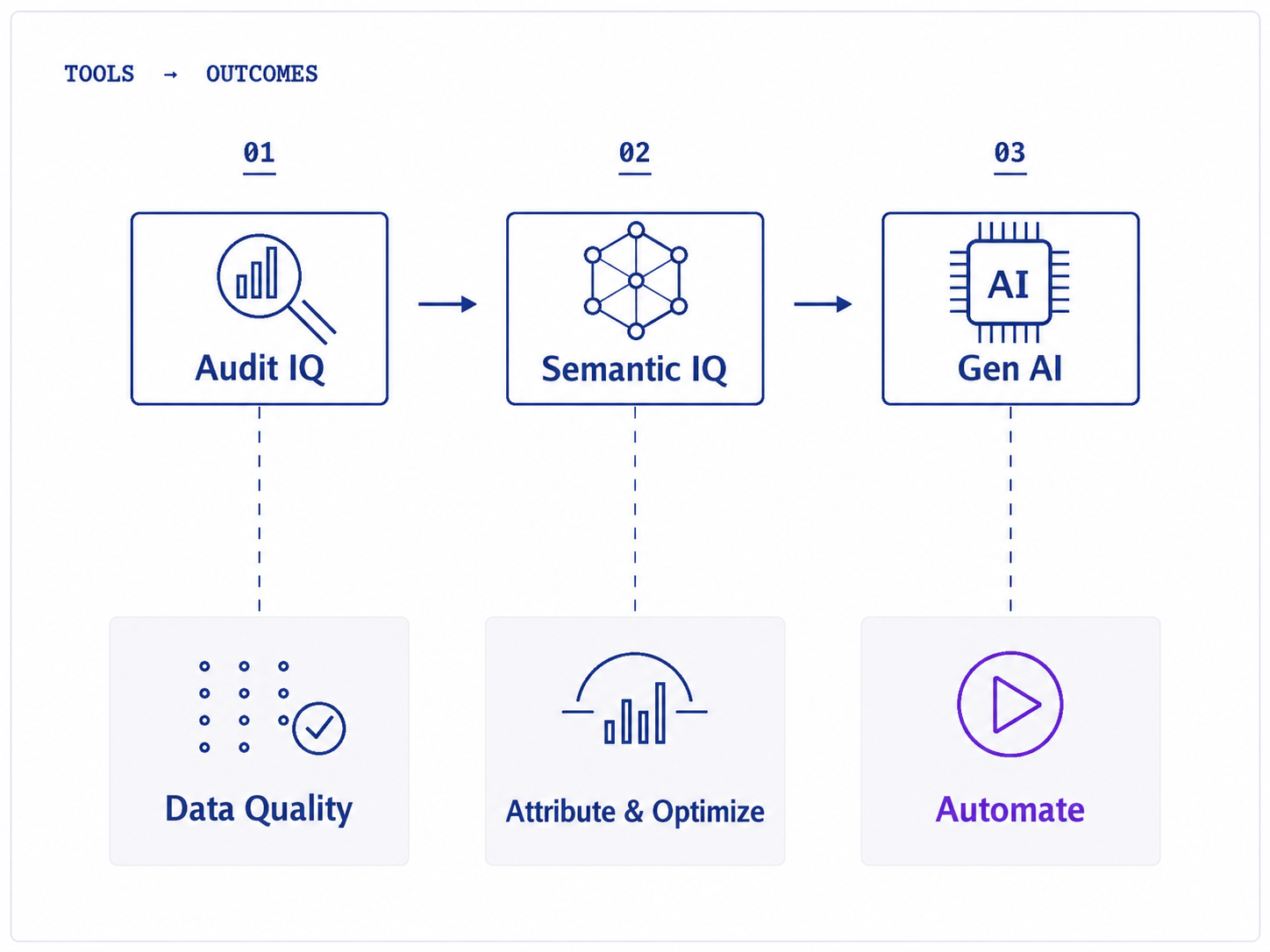
Co-optimization is the middle of a stack, not the top. The order matters: data quality, then attribution, then optimization, then automation. You cannot prove optimization without attribution. You cannot do attribution without clean, reconciled data. Reverse the order and the agent at the end of the pipeline is automating a guess.
This is why the Semantic Brain App is built the way it is. Audit IQ handles data quality. Semantic IQ handles attribution and optimization, with BizML as the engine. Gen AI sits on top and automates the prescribed action. Skip a layer and the layer above it stops being trustworthy.
Gen AI is genuinely useful. It is not, by itself, sufficient. There are problems it cannot solve, and optimization across noisy marketing data is one of them. Treating “agent” as the answer to “how do we optimize” is a category error — it asks a reasoning system to do a measurement job. Optimization is the goal. Attribution is the prerequisite. Data quality is the prerequisite to that. And Analytics — real, computational Analytics — has to be in the stack underneath the agent, doing the work the agent cannot.
Calculate first. Then reason. Then automate. In that order.