
Factory robots stirred fear and skepticism. Their larger opportunity emerged when businesses invested in better processes, complementary technologies and people. That history offers a hopeful, practical lesson for leaders adopting AI.
In 1961, a mechanical arm began unloading hot metal castings at a General Motors plant in New Jersey. Built by Unimation, the robot took on work that people found dangerous and unpleasant. Its first deployment attracted little opposition from the workers there.
As robots moved further into factories, the stakes became more personal. A machine that could repeat a task all day raised questions about the future of a skill, a paycheque and a place in the workforce.
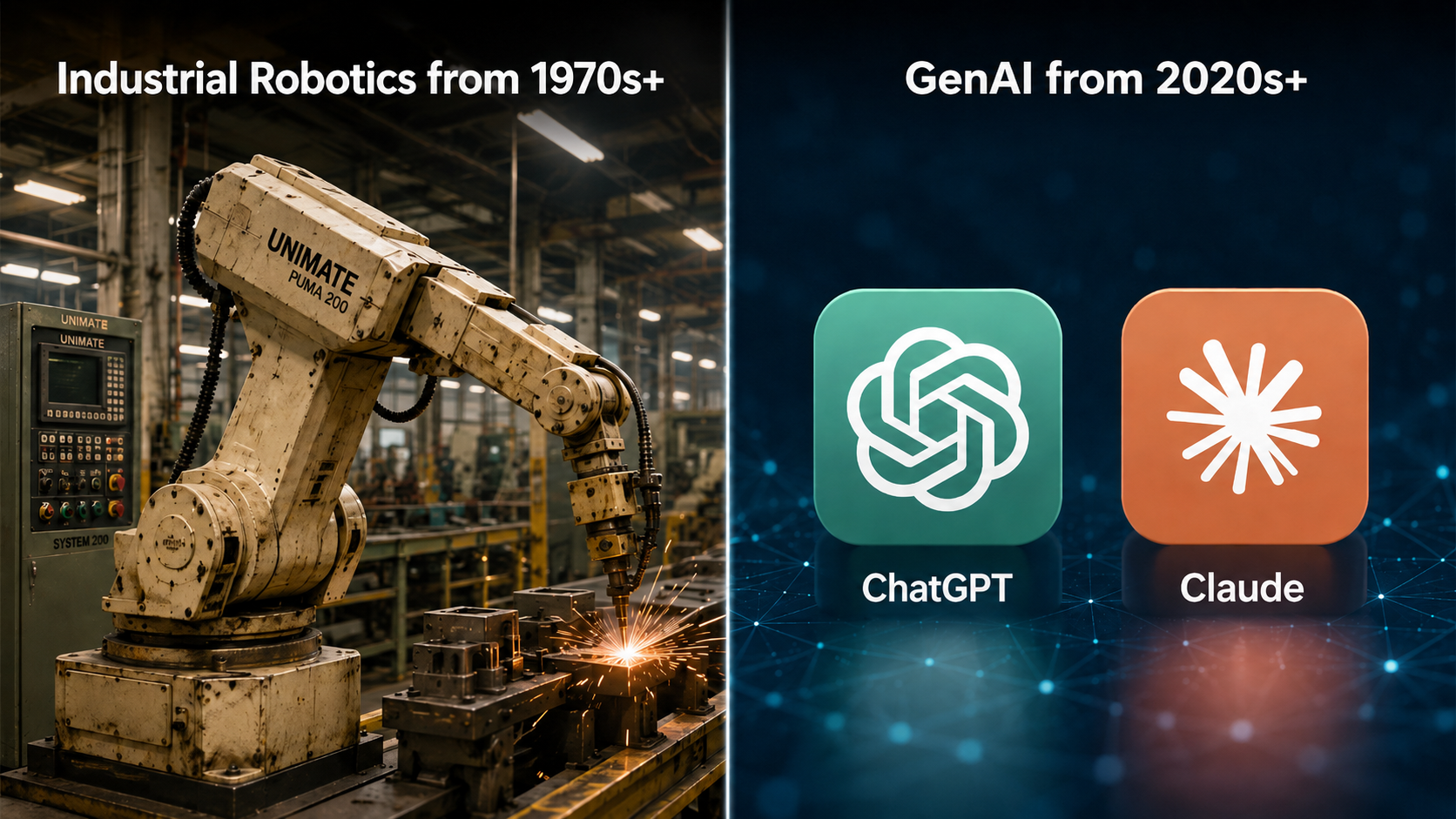
Today, AI brings that uncertainty into offices and professional work as well. The history of robotics offers a reason for hope: businesses can use new capabilities to build more productive, more capable operations and create room for growth. Making that happen takes sustained work.
A machine could be feared and dismissed at the same time
For workers, the anxiety was understandable. Livelihoods were at stake. For business leaders, early robots raised doubts about reliability and whether the investment would ever pay off. The same technology could seem too limited to trust and powerful enough to threaten someone’s future.
Public introductions also made robots look like a novelty. In 1966, Joseph Engelberger brought Unimate onto The Tonight Show, where it poured beer, knocked a golf ball into a cup and conducted the band, according to the Association for Advancing Automation. A robot could entertain an audience even while its place in the factory remained contentious.
Some doubts had a sound basis. A historical account puts the first Unimate’s production cost at roughly US$65,000 and its selling price at US$18,000. Unimation did not become profitable until 1975. Commercial success took years.
Worker reactions changed with the circumstances. At GM’s Lordstown plant, a larger robot deployment drew protests. Later changes brought layoffs, faster line speeds and a punishing workload; a strike shut the plant for 22 days in 1972. The Lordstown history shows how automation became entangled with decisions about how people were treated.
That distinction matters. Fear was not simply ignorance that progress would eventually sweep away. People were responding to real decisions and real consequences. An account of technological success has to make room for them.
Yet fear and dismissal could also obscure a larger possibility. A robot might help a business increase capacity, improve quality or make a more flexible production system possible. Those opportunities became clearer as the machines and the operations around them improved.
Some adopters stayed with the difficult work
Japan’s manufacturers did not receive perfect machines. Kawasaki’s early robots fell short of the reliability standards expected by automotive customers. Growing demand and labour shortages made the opportunity worth pursuing, but the technology still needed substantial improvement.
Kawasaki describes engineers and technicians at customer companies working with its robot division to improve performance. Its history of those early years is a story of persistence, learning and collaboration. The people closest to the problems helped develop the capability that factories needed.
For leaders adopting AI, there is a useful lesson here: commitment means investing in the work required to make a promising capability useful. It includes listening to people, redesigning processes and testing performance.
The opportunity became much larger than the first task
The first robot unloaded castings. Over time, robotics became part of systems for welding, inspection, materials handling and flexible production. Each new application brought another opportunity to improve what a factory could deliver.
By 2025, around five million industrial robots were operating worldwide. Factories installed more than 600,000 new units that year; China accounted for 59% of deployments, according to the International Federation of Robotics.
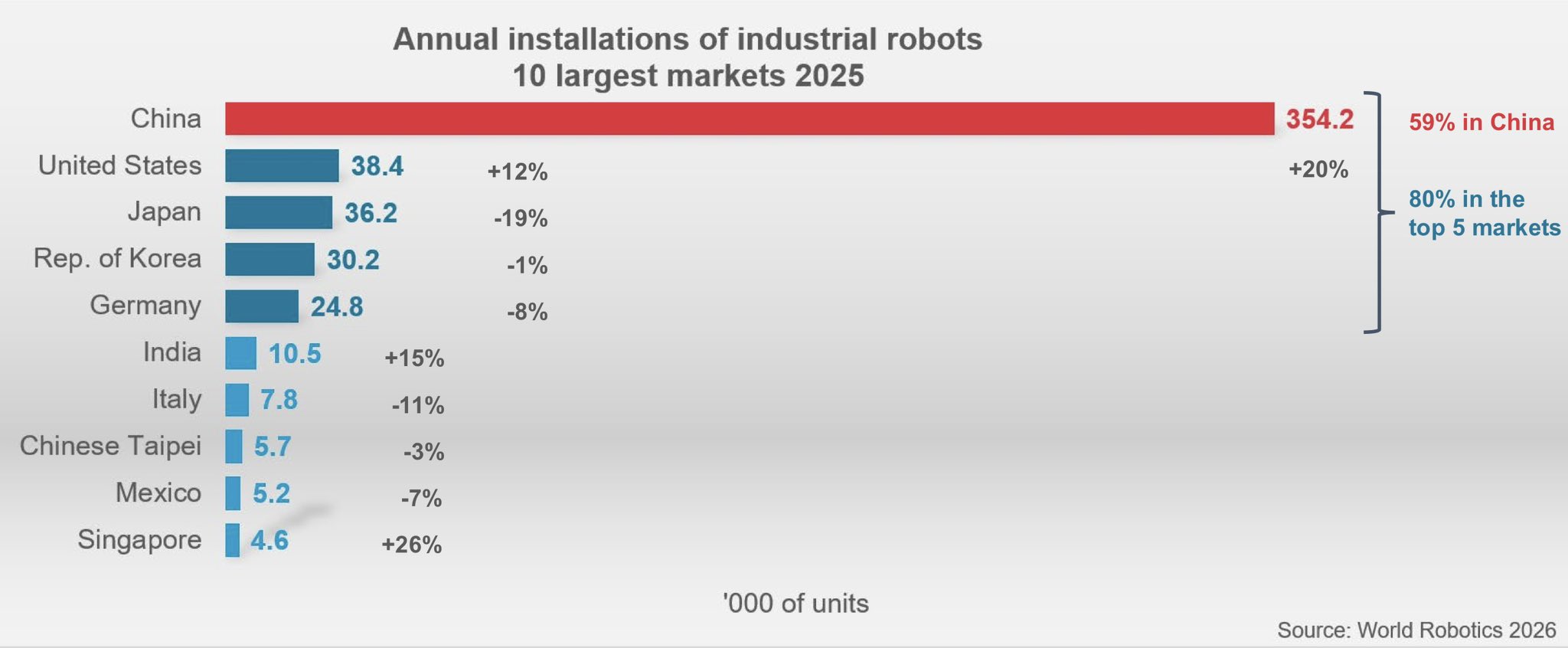
For something once unfamiliar and difficult to commercialise, that is a remarkable scale of adoption. The business lesson becomes clearer when we look inside the factories: the gains depended on what companies built around the robots.
Toyota built flexibility into the system
Toyota needed production systems that could accommodate different models and markets. Its Global Body Line supported small-lot production as well as mass production. Digital engineering helped shorten its development period to two years, compared with four years for the earlier Flexible Body Line.
At Takaoka, assistive robots, automated inspection and better parts supply helped create a line capable of producing a vehicle every 50 seconds in 2007, according to Toyota’s account. The opportunity included speed, quality and the ability to respond to demand.
Toyota also acknowledges higher investment costs and overseas rollout before domestic performance was fully verified. Its experience shows both the potential of a broader approach and the discipline needed to realise it.
LG connected execution with intelligence
At LG Smart Park in South Korea, robots operate alongside digital twins, automated material transport and analytics that help anticipate defects. Together, these capabilities help workers identify problems and coordinate production.
LG reported a 17% increase in units produced per hour and a 70% reduction in the cost of defective-product returns from 2020 to 2021, citing its World Economic Forum lighthouse site-visit report. These are results of the combined transformation; the return-cost measure is distinct from the defect rate.
The value extended across the business. More output created capacity. Better quality reduced waste and return costs. Improved coordination helped the factory respond to customer requirements. Robotics contributed within a system that made those outcomes possible.
Growth could benefit people too
The fear was that machines would make people poorer. South Korea and Singapore offer a hopeful counterpoint: extensive robot adoption can coexist with rising living standards. In IFR’s 2024 data, they rank first and second in industrial robot density, with 1,220 and 818 robots per 10,000 manufacturing employees, respectively.
Both countries have made substantial progress in human wellbeing. Between 1990 and 2023, UNDP’s Human Development Index rose from 0.738 to 0.937 in South Korea and from 0.819 to 0.946 in Singapore. The index combines health, education and income, capturing more of people’s lives than factory output alone.
Singapore now stands near the very top of global prosperity rankings. In the IMF’s 2026 projections, it ranks second worldwide by GDP per person adjusted for purchasing power, behind Liechtenstein. This measure accounts for differences in price levels.
Robots alone did not create that prosperity, and these comparisons do not establish causation. Their adoption can be read as a sign of a broader willingness among businesses and workers to learn, adapt and build new capabilities. Singapore’s SkillsFuture programmes support that approach through workforce training and job redesign. Robot density demonstrates deployment; it cannot tell us how every citizen felt about the change.
There is also evidence of a direct growth mechanism. A study of Japan covering 1978–2017 found that falling robot prices increased adoption and employment by raising productivity and expanding production in adopting industries.
The costs were real as well. US research found adverse employment and wage effects in labour markets more exposed to robots. National prosperity does not guarantee that every worker benefits.
For leaders, the hopeful lesson is that people can build a better future alongside new machines when they have opportunities to learn and help shape the change. Skills development, involvement in process design and support through changing roles belong in the investment from the beginning.
AI gives business leaders another opportunity to choose
Industrial robotics concentrated its most immediate employment concerns in factories. AI reaches into a much wider range of everyday work. That makes the question of how people participate in adoption especially important.
A team that sees AI only as a threat has little reason to contribute its knowledge. A team that receives a tool without a clear purpose may produce more activity with little business benefit. Leaders can make a broader opportunity concrete by involving people in solving problems that matter.
In marketing and sales, that might mean discovering which customers are poorly served, improving conversion or deciding where investment could generate better returns. AI can help a team explore options and act on them. Analytics provides evidence about performance; software connects the data and workflows; people supply context and judgment.
Consider a marketing team under pressure to produce more content. A wider approach would examine which audiences, messages and channels offer the best opportunities, test improvements and then expand the activities that work. The team gains a stronger basis for decisions as well as greater capacity to execute.
The business goal guides the technology. Define the outcome, establish a baseline, develop the necessary skills and test changes before expanding them. Measure growth, margins, quality and waste alongside hours saved.
The history of robotics gives CEOs a useful reason to look beyond the immediate replacement story. New capabilities can help businesses serve more customers, deliver better products and open up opportunities. Building that future takes patience and a view of the whole system.
How Semantic Brain applies this lesson
At Semantic Brain, we help marketing and sales teams make smarter decisions and grow faster—without the guesswork. We combine LLM reasoning, analytics and software to identify growth opportunities, reduce waste and support execution.
BizML is the proprietary intelligence engine that powers Semantic IQ. Alongside human expertise and LLM reasoning, it helps teams understand performance and decide what to improve. Our aim is to strengthen what teams can accomplish and help them think and act more strategically.
Industrial robotics began with individual tasks and developed into a much broader capability. We see that as a useful lesson for AI: plan for growth, connect complementary technologies and give people the means to turn new possibilities into business results.
Start exploring the possibilities for your business with Semantic Brain.