
On November 3, voters in Texas and Georgia elected candidates who had campaigned partly on pausing data-center development. Reuters called the results a demonstration of the power of data-center opponents.[1] Electricity, water, and who benefits locally have become decisive issues at the ballot box.
Those votes reflect a wider push to slow down, led by some lawmakers and backed by much of the public. In March, Senator Bernie Sanders and Representative Alexandria Ocasio-Cortez introduced a bill for a federal moratorium on AI data centers.[2] In July, New York became the first state to pause permits for new hyperscale data centers.[3] In a late-September Quinnipiac poll, nearly eight in ten Americans favored slowing or stopping advanced AI development, and 72% said they would oppose a data center in their community.[4] Washington is split: President Trump has pushed back against slowing AI development, citing the risk of China gaining an advantage.[5]
The concerns behind those votes are reasonable. Data centers put heavy demands on power grids and water supplies. AI is already changing how many people get hired in marketing, software, and customer service. Safety researchers warn about risks nobody yet knows how to fully control. Against that backdrop, slowing down looks like the prudent choice. Wait, learn more, and let someone else make the early mistakes.
That logic has a hidden assumption: that everyone else waits too. They won’t. Once you account for how competitors and other countries respond, pausing becomes one of the riskiest moves a company or a country can make.
“Pause” can mean three things: stop frontier labs from training more capable models, stop building data centers, or stop companies from putting AI to work. This post is about the last two. Frontier risk is a separate debate, and we come back to it at the end. For most companies, the pause is not a policy. It is a wait: another pilot, another quarter, another review until the tools settle down.
The safe bet assumes nobody else moves
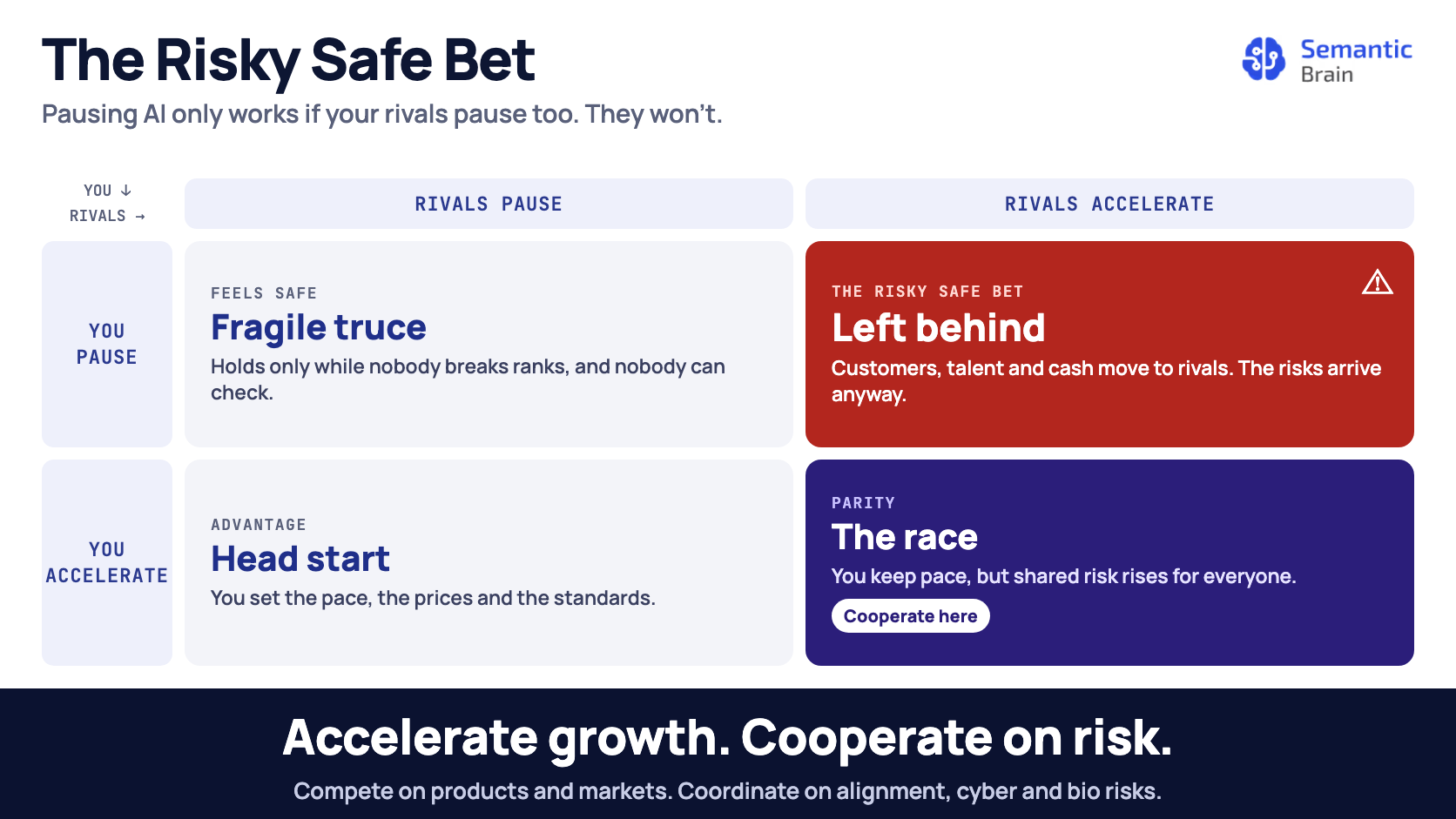
Game theory studies decisions where your outcome depends on what others choose. Picture a company deciding whether to put AI to work now or wait, or a country deciding whether to keep building data centers, while its rivals make the same decision.
If everyone holds back, the arrangement feels safe. It is also fragile. Each player gains by quietly breaking ranks, and nobody can verify that the others are holding back. If you accelerate while rivals hold back, you get a head start. If everyone accelerates, you keep pace in a race where shared risk rises.
The outcome to fear is the one that looks most responsible: you hold back while your rivals accelerate. Your costs rise relative to theirs. Customers, talent, and investment flow to the faster players. The technology keeps advancing, so the risks you hoped to avoid still arrive. You just have less say in how they are handled.
Whatever your rivals do, you end up better off accelerating than holding back. In game-theory terms, acceleration is the dominant strategy. A unilateral pause is a bet that your competitors will act against their own interests.
The weavers already played this game
Textiles offer a historical version of the same choice. Mechanized weaving changed how cloth was made. Using equipment figures from a 1997 study of the Indonesian textile industry, a modern jet loom produces roughly 400 to 500 times more cloth per worker-hour than a handloom.[6]
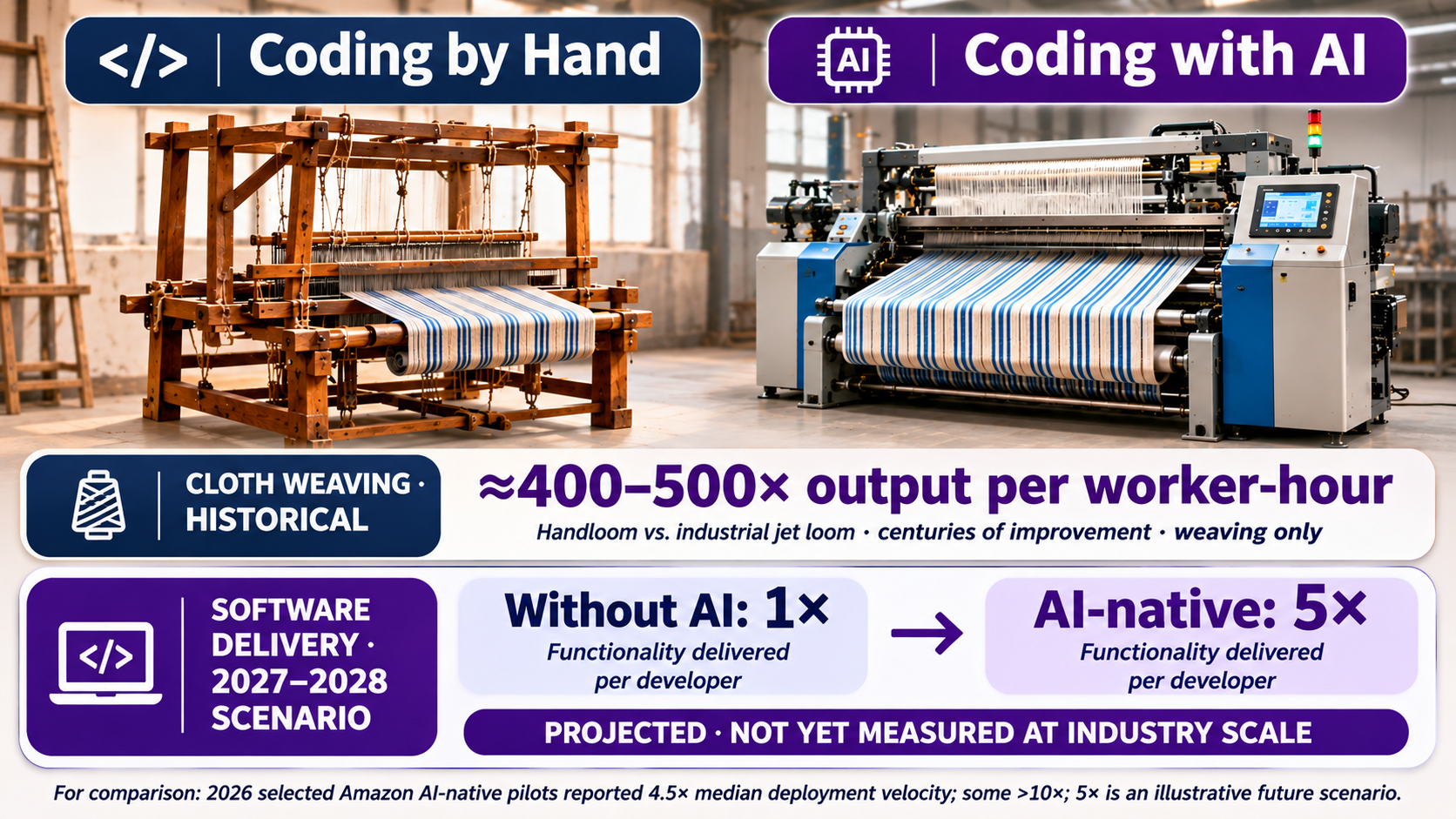
The loom ratio is equipment-specific, not a universal benchmark, and the 2027–2028 software figure is a scenario. Amazon’s pilot results measure normalized deployment velocity.[7]
Between 1811 and 1816, English textile workers known as Luddites smashed the machines they blamed for falling wages and lost work. Their grievances were real, and the displacement was painful. But breaking frames in Nottinghamshire did not stop machine-made cloth. Production carried on wherever owners adopted the new equipment. A mill that refused power looms, or waited for them to prove themselves, did not save handloom jobs. It handed its customers to competitors with lower costs.
Britain could afford some of that resistance because it had no close rival, and its lead still did not last. Britain banned the export of textile machinery, yet Samuel Slater and later Francis Cabot Lowell carried the designs to America in their heads. Within a few decades, the United States had a textile industry of its own.
Today’s United States has no such cushion. China is a peer competitor in AI models, chips, and infrastructure, and the distance between them is far narrower than Britain’s lead ever was. Export controls on advanced chips play the role Britain’s machinery bans once did: they can slow diffusion, but they cannot substitute for staying ahead. A pause that a dominant Britain might have absorbed would hand the lead directly to a rival already close behind.
The bigger story happened downstream. Cheaper fabric became the input for clothing, upholstery, and countless other products, and around those products grew businesses in design, finishing, distribution, branding, and retail.
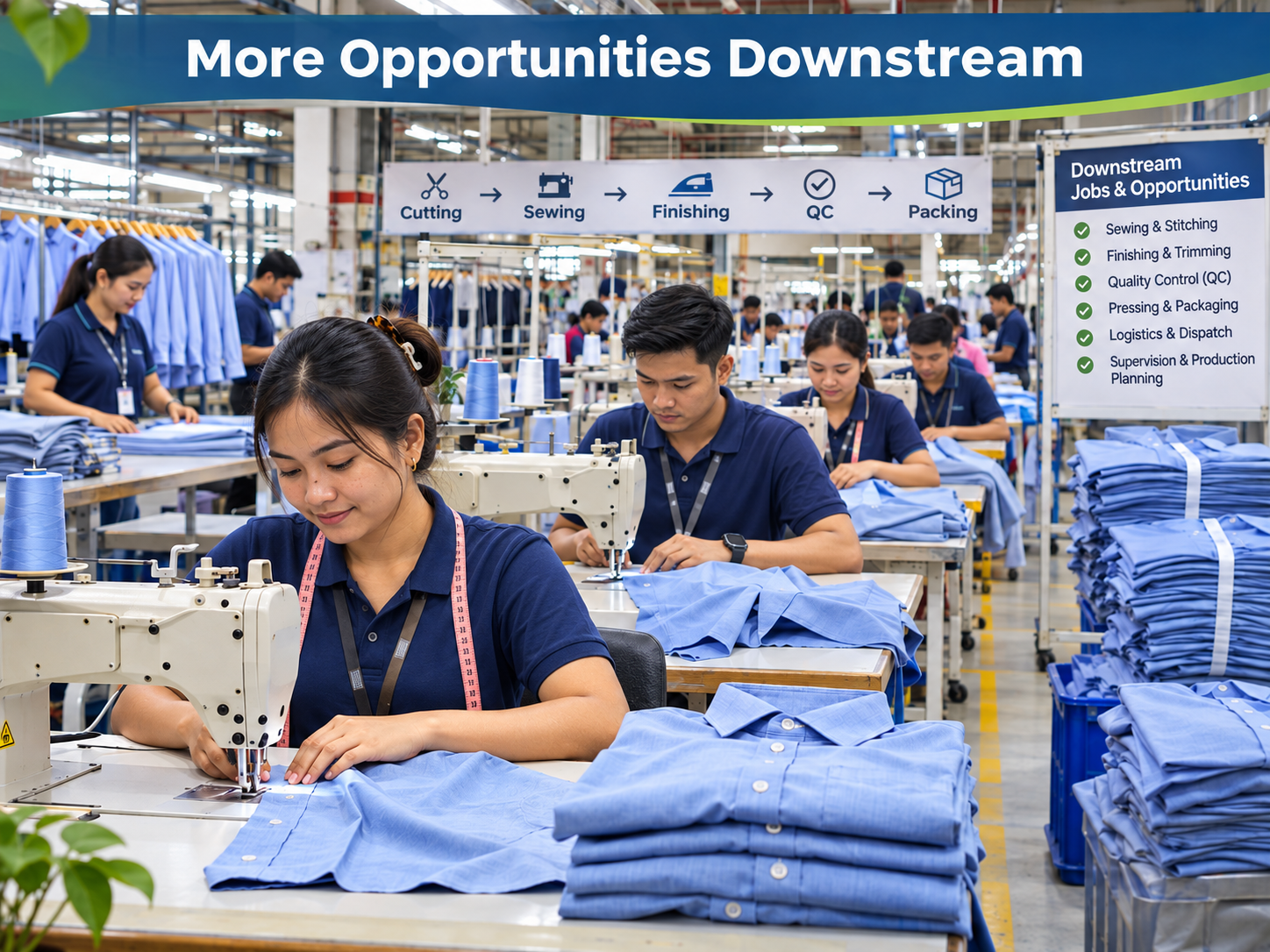
James Bessen’s research on the US textile, steel, and automotive industries shows the mechanism. Automation initially increased employment because falling prices expanded demand strongly. Employment declined later, once demand stopped responding.[8] The winners were the people who used cheaper inputs to make something new that customers wanted.
Falling behind compounds
AI productivity tools become table stakes fast. The Content Marketing Institute’s report for 2027 found that 88% of surveyed B2B marketers use AI tools to create content. In Stack Overflow’s 2026 developer survey, roughly 66% of respondents use AI coding assistants or agents.[9][10] When most of a field works this way, the team that doesn’t is competing with a higher cost base.
The gap widens as teams rebuild how they work. In June 2026, AWS reported a median 4.5-fold improvement in normalized deployment velocity across Amazon Stores pilots that adopted AI-native tools and practices.[7]
Falling behind then feeds on itself. Higher unit costs squeeze margins, which leaves less to invest in the next round. Skilled people move to organizations with better tools. Teams that deploy early learn what works in their own business, and that learning cannot be bought later. Each round of delay makes the next round harder to close.
This is why waiting to see is not a neutral position. A company that holds off for a year while the tools mature does not get last year’s tools at a discount. It gets this year’s tools and a year less experience using them than its competitors.
Demand will find a supplier
Restricting supply can work when demand is flat and buyers have nowhere else to go. Neither is true of AI.
Demand from companies is growing fast. Anthropic’s revenue for the third quarter of 2026 was $17.0 billion, up from $1.4 billion a year earlier, a 12-fold increase.[11] Over the same year, its count of customers generating more than $100,000 in annual revenue rose from about 950 to more than 11,900.[12]
Alternate suppliers are ready. Chinese open-weight models such as DeepSeek and Qwen cost 60% to 90% less than leading US offerings. Since February 2026, they have handled at least 30% of enterprise token volume on OpenRouter, a platform that routes requests across models, peaking at 46%.[13] Thomson Reuters built its in-house model on Alibaba’s Qwen.[14]
When demand is growing and substitutes exist, a pause does not reduce AI use. It changes who supplies it. A local moratorium sends the data center, the construction jobs, and the tax base to another state or country. A national slowdown pushes companies toward foreign models and foreign capacity. The productivity gains still happen, but the products, margins, and jobs built on them land somewhere else. That is the likely blowback: more unemployment and a lower standard of living in the places that tried to protect both.
Acceleration has to mean growth
Here the skeptics have a point. If acceleration only means smaller teams and a lower wage bill, people have little reason to accept the disruption and resource demands that come with it. The case for moving fast depends on growth: better products, new customers, and markets that did not exist before.
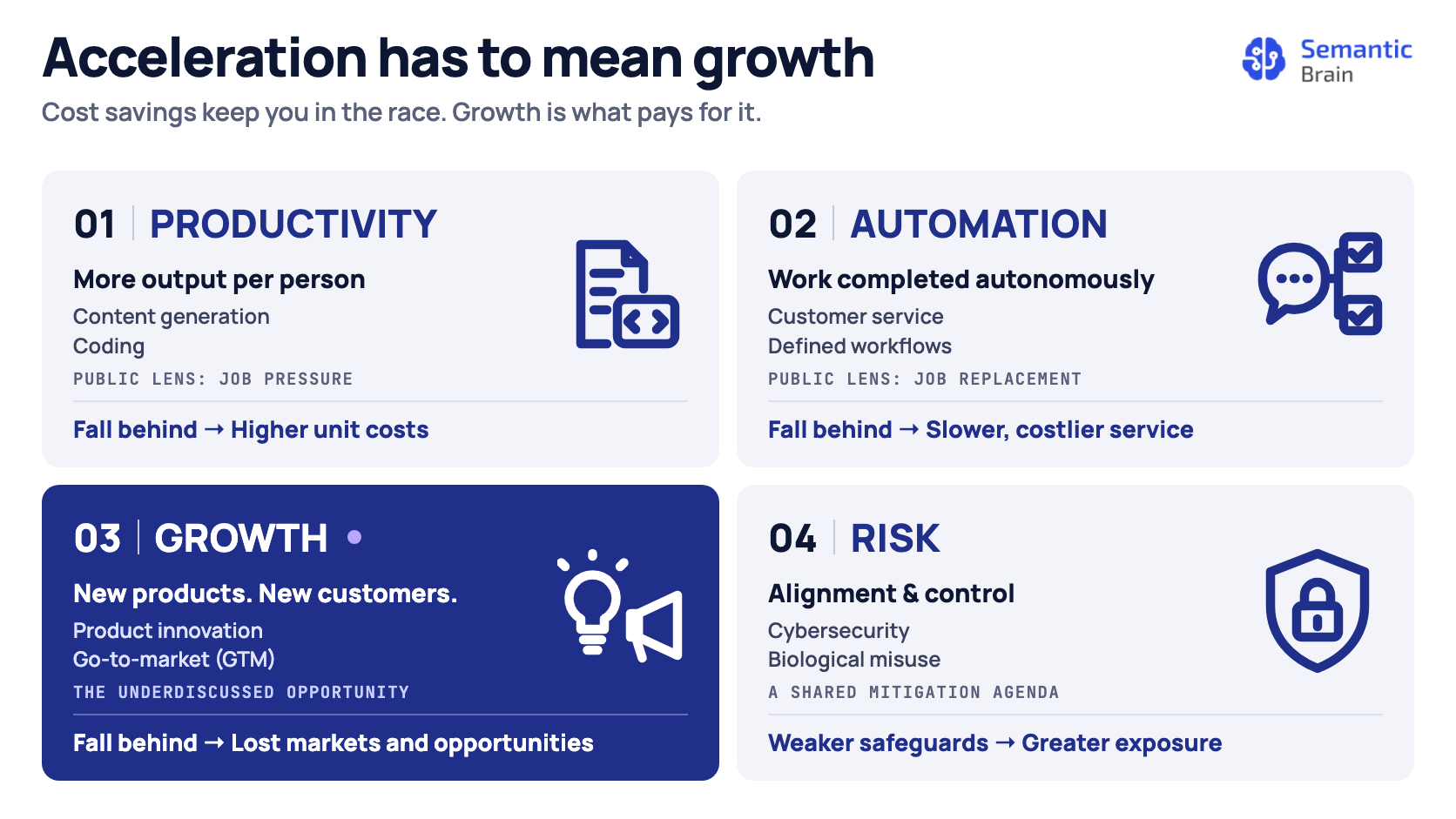
AI can lower the cost of important inputs the way the power loom lowered the cost of cloth. Cheaper software development makes previously uneconomic applications viable. Cheaper content and localization let a small business reach customers it could never serve before. In medicine, systems such as DeepMind’s AlphaProteo design novel protein binders for research, though turning a candidate into a treatment still requires extensive validation.[15]
Growth also depends on reaching customers. Marketing and sales teams decide which buyers to serve, which problem to lead with, which offer and price to test, and where to invest. Producing more campaign assets helps. Finding an underserved segment with a problem worth solving changes the business.
This is the growth problem we work on at Semantic Brain. We combine proprietary analytics with LLM reasoning to help marketing and sales teams understand customer and channel performance and prioritize their next moves. A business might discover, for example, that a smaller audience responds to an offer far more profitably than the broad audience it has been targeting.[16] That is acceleration aimed at better decisions, as well as faster execution.
The one place to cooperate: risk
Go back to the matrix. When everyone accelerates, shared risk rises. Alignment and control determine whether systems behave as intended and whether humans can supervise or stop them. AI can help cyber attackers as well as defenders. Biological misuse carries high-consequence dangers of its own.
This is where the frontier debate belongs, and the same logic applies. A unilateral pause does not solve it. It moves you into the worst cell while the race continues without you. The answer is to change the game where losing would be catastrophic. That means shared evaluation methods, incident reporting, restricted access for the most dangerous capabilities, and the governance capacity to enforce them. A company buying a business application and a lab releasing a more powerful frontier system face very different decisions. The safeguards should reflect that.
Rivals can do this while they compete. During the Cold War, the United States and the Soviet Union negotiated arms-control agreements while competing on almost everything else. On AI, the United States and China have already found common ground. Both signed the 2023 Bletchley Declaration, which recognized the need for international cooperation on frontier AI risks.[17] The next step is cooperation on evaluations, serious incidents, and dangerous misuse, with each country accountable for its own systems.
Give people a reason to back the race
The voters and lawmakers pushing for pauses are right about the costs. A pause does not remove them. It gives up the benefits that could pay for them, and hands the technology’s direction to someone else.
Companies and countries should accelerate, and then prove it was worth it. That means useful products, more affordable services, opportunities people can share in, and real support for those whose work is displaced. Public confidence will depend on results that go beyond a smaller wage bill.
Accelerate growth. Cooperate on risk.
Sources
- Reuters — Trump’s midterm drubbing demonstrates the power of data center opponents — November 4, 2026.
- Office of Sen. Bernie Sanders — Sanders, Ocasio-Cortez Announce AI Data Center Moratorium Act — March 25, 2026.
- Bloomberg Government — New York Leads Nation in Moratorium on New Big Data Centers — July 14, 2026.
- Beinsure — 86% of Americans back independent AI safety standards (Quinnipiac University poll) — September 2026.
- AP-NORC — Most Americans think artificial intelligence is developing too fast — October 8, 2026.
- Riek van der Kamp — Technology and Human Resources in the Indonesian Textile Industry — 1997, appendix on machine productivity.
- AWS — How frontier teams are reinventing AI-native development — June 10, 2026.
- James Bessen — Automation and Jobs: When Technology Boosts Employment — Economic Policy, 2019.
- Content Marketing Institute — B2B Content and Marketing Trends: Insights for 2027 — November 4, 2026.
- Stack Overflow — Developer Survey 2026 AI data — 2026.
- Fortune — Anthropic’s growth slowed and costs jumped in the third quarter, updated IPO filing shows — November 2, 2026.
- TechFlow — Anthropic posts operating loss in Q3, compute commitments reach $895.4 billion — November 2026.
- Forkast (reporting a CNBC investigation) — Chinese AI models now capture up to 46% of US enterprise token usage — July 2026.
- Fortune — Chinese open-source AI is starting to win over U.S. businesses — August 27, 2026.
- Google DeepMind — AlphaProteo generates novel proteins for biology and health research — September 5, 2024.
- Semantic Brain — Semantic IQ — Company product description.
- UK Government — Countries agree to safe and responsible development of frontier AI — November 1, 2023.