
Every rushed automation project rests on an assumption nobody says out loud: that because Gen AI is faster and cheaper than people, it must also decide better than people. The first two are measurable and real. The third gets the question wrong. Judgment isn’t a fixed property of humans or machines — it’s built, and both build it the same way: on attribution.
Gen AI and Gen AI agents deliver genuine savings in cost, time, or both on work that used to require a person. That much is settled. The open question is judgment — and the honest answer is that out of the box, neither Gen AI nor a human has good judgment about your marketing and sales. Attribution improves both. Attribution plus Analytics improves both further. And where data runs out, human judgment leads. That order determines everything about what to build first.
Judgment is built, not assumed
If Gen AI had better judgment built in, the right move would be exactly what the market is doing: connect it to everything and let it run. Point an LLM at GSC, GA4, Google Ads, and the CRM, and expect analysis to come out the other side. The demo is convincing and the connectors are easy to build. Plenty of teams stop there and expect superior output.
But connectors move data. They don’t reason about it. Gen AI and LLMs are not calculators — they reason over language, they don’t compute over structured analytics. Feed raw GSC/GA4/Ads data straight to an LLM and you get two things you didn’t want: hallucinations and runaway cost.
Take a concrete case. A team connects GA4 and Google Ads to an LLM and asks which campaigns to cut. It gets back a confident list. The catch: the model read last-click rows as if they were contribution, so it flags a campaign that assists conversions higher up the funnel. Cut it, and pipeline downstream drops a month later — with nothing in the report tying the cause to the effect. The output was fast. The judgment was wrong.
Note what actually failed there. Not the model — the attribution. A person handed the same last-click rows would have made the same cut. Judgment, human or machine, is only as good as what it can see, and attribution is what lets either one see contribution instead of coincidence.
So the fix is mechanical, not motivational. Semantic IQ pre-structures the analytics first, so the reasoning has something reliable to stand on. Analytics quantifies what happened; LLM reasoning interprets it. Run them together and you get diagnostic insight and prescriptive solutions — output that can then be handed to Gen AI to execute, or to a person to act on. Each layer raises the ceiling: attribution improves both human and Gen AI judgment, and attribution plus Analytics improves both further.
Where data runs out, human judgment leads
Attribution and Analytics raise the ceiling on every decision they can reach. But not every decision is reachable. Strategic and creative calls often can’t be data-driven: sometimes the data doesn’t exist, and sometimes gathering it would cost more or take longer than the decision is worth. Which segment to enter, how to position against a shift in the market, what the brand should sound like — Analytics can inform these, but it can’t settle them.
That’s the real division of labor, and it sets the level of human involvement. Automation is a spectrum, not a switch, and two positions on it are worth naming:
Human in the loop (HITL). A risk-reduction posture. Gen AI does the work; a person stays informed, reviews, approves, and edits where needed. You trade some speed for a lower error profile.
Human-directed. For the decisions data can’t reach. People supply the strategic and creative judgment; Gen AI and Analytics generate options, pressure-test them, and do the grunt work and the heavy lifting underneath the call.
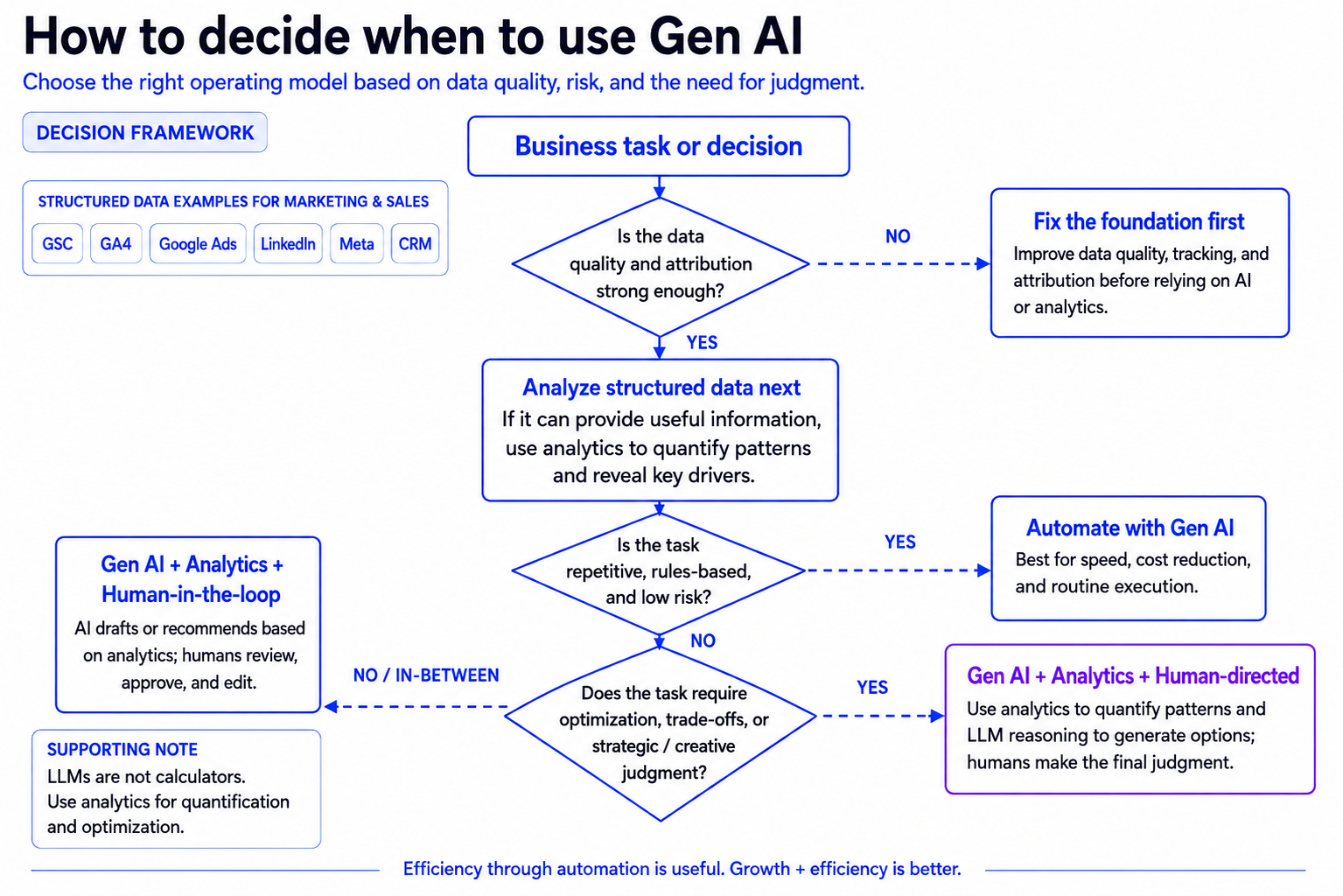
Start with data quality and attribution. With structured data in place, run Analytics — then let risk and the need for judgment set the level: full Gen AI for low-risk, rules-based work; human-in-the-loop in between; Gen AI + Analytics + human-directed where strategic or creative judgment is required.
Three tasks, three levels
The framework is easier to trust with the tasks filled in.
Generate 200 ad-copy variants for an A/B test. Repetitive, low-risk, fully reversible — and no judgment required, because the test supplies the judgment. Full Gen AI automation.
Draft the lifecycle emails that go to real customers. A bad send is public and hard to walk back. Human-in-the-loop: Gen AI drafts, a person approves and edits before anything leaves.
Decide which segment to enter next quarter. The data to settle this may not exist, and buying certainty would cost more than the decision is worth. Human-directed: Gen AI and Analytics generate and pressure-test the options; a person makes the call.
Same toolset, three different levels of human involvement — set by risk, and by whether the judgment the task needs can be data-driven at all.
What every level runs on
Whatever the level, the floor is the same. Without quality data, Gen AI and Analytics will underperform the very people they were meant to replace — and the people won’t do much better, because they’re reading the same broken numbers. That is what Audit IQ handles first: data quality and governance, before anything reasons over the figures.
Attribution is the second precondition. Without it, every call is blind — how else would you know what can be improved, or whether anything you changed actually improved? Attribution is what Semantic IQ establishes before it optimizes. It’s also what makes the human-directed calls better: even a decision that can’t be data-driven is sharper when the decider knows what has actually been working.
That gives the order the whole approach depends on: attribution then optimization before automation. Not a preference. A sequence.
The cost of betting wrong
Here is what the wrong answer to the title question looks like on a chart. Jumping straight to Gen AI can lift revenue faster at first — in marketing it is the quickest way to produce more content, and in product it is the quickest way to ship more functionality. Volume is the easy win.
The catch is targeting. Take a team that uses Gen AI to move blog and LinkedIn output from four posts a month to forty. The first weeks look strong — more surface area, more impressions, an early bump. But none of that volume is aimed: no attribution told them which topics or segments actually convert. Engagement per post slides, the audience tunes out, and the channel’s baseline settles lower than where it started. Attribution first would have named the three topics worth scaling — then Gen AI scales those, and the volume compounds instead of decaying. That is the automation-only curve: a fast start, then a fall.
Gen AI is one tool among several, not the strategy itself. Establish attribution, optimize against it, and then automate — and the same speed produces targeted output instead of noise. The answer to the title question, then: Gen AI doesn’t arrive with better judgment, and neither does anyone else. Attribution builds it, Analytics compounds it, and human judgment carries the decisions data can’t reach. Efficiency through automation is useful. Growth and efficiency is better.
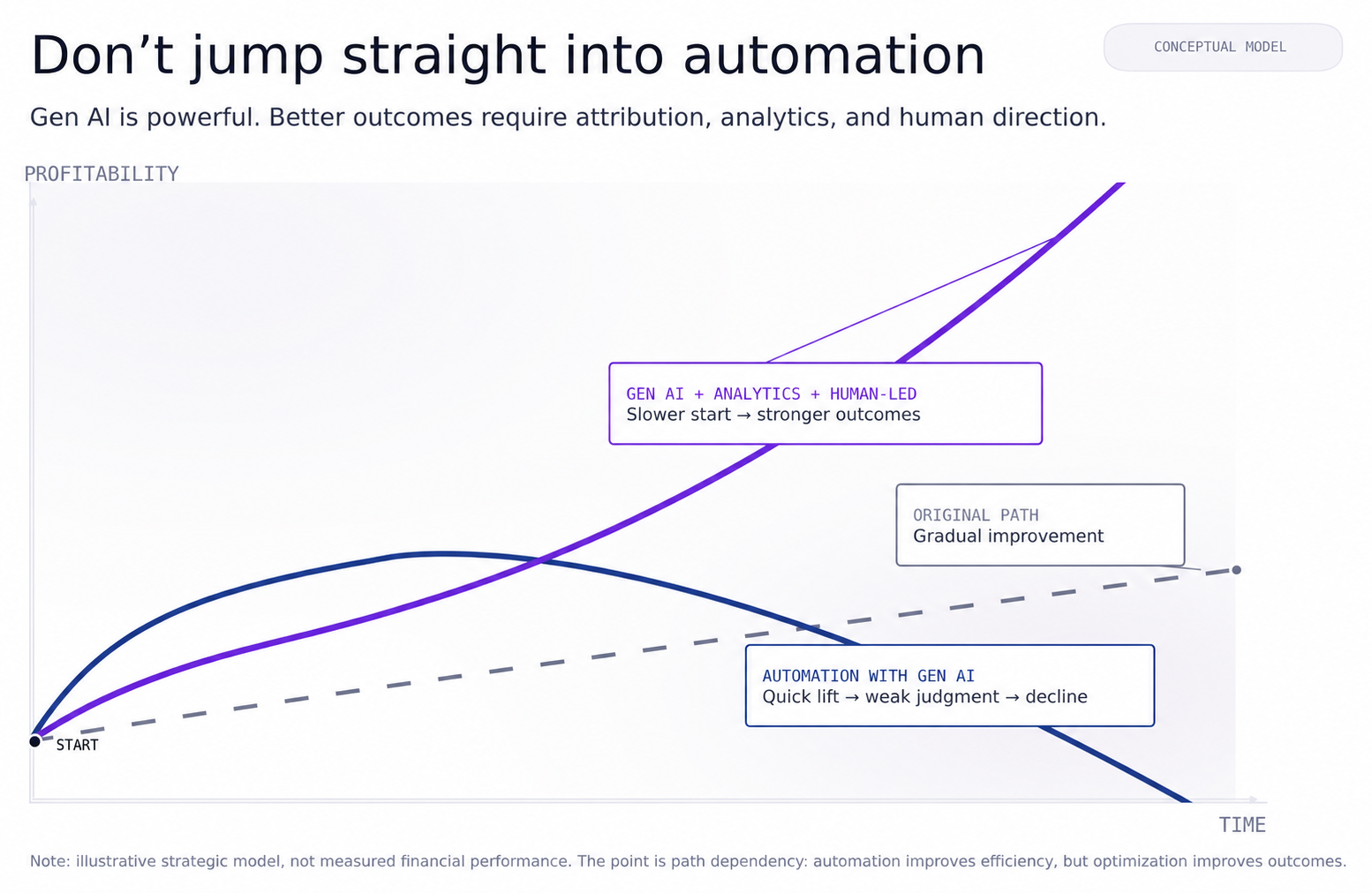
Automation with Gen AI lifts profitability fastest at first. Gen AI + Analytics + human-led starts slower, then passes every other path and keeps climbing.